
In modern motorcycle manufacturing, plastic injection molding has evolved far beyond the production of simple components. It has become a critical driver for design innovation, performance enhancement and cost optimization. From the eye-catching body panels to the heart of the powertrain and even into the fully automated workshop, this efficient and versatile process is omnipresent. Its core advantages – high design freedom, large-scale production efficiency, significant lightweighting potential, and a wide range of material properties – make it indispensable in the industry.
1. Application Landscape: From Exterior Aesthetics to Functional Core
Injection molding technology is extensively used across various motorcycle systems. These applications can be grouped into four main categories:
Body Panels and Exterior Systems
This is the most visible area for consumers and the most mature application field for injection molding. Components such as fenders, side covers, fairings, and hand guards are typically produced using one‑shot injection molding. This process accurately achieves complex, aerodynamic surfaces while ensuring seamless aesthetics. Compared to traditional metal parts, plastic panels significantly reduce weight, are corrosion‑free, and offer excellent durability. Moreover, by integrating multiple metal sub‑components into a single molded part, assembly steps, logistics costs, and overall production complexity are substantially reduced.
Furthermore, advanced surface treatments such as textured finishes, matte coatings, and high-gloss polishing are applied to enhance visual appeal and tactile quality. The ability to incorporate decorative elements directly into the mold—such as logos, textures, or color patterns—further amplifies customization options, enabling manufacturers to deliver unique and brand-specific designs efficiently.
Functional Structural Parts and Electrical Systems
Inside the motorcycle, many critical structural and protective parts rely on injection molding. Battery cases, air filter housings, and carbon canister bases require high impact resistance, chemical resistance, and long‑term stability. Injection molding allows the use of specialized engineering plastics to reliably protect sensitive components such as battery packs and electronic control units. A notable example is found in some electric motorcycles, where high‑performance plastic is used to mold core subframe components—demonstrating the growing potential of “plastic instead of metal” in structural applications.
Lighting Systems
Headlights, turn signals and taillights – both housing and lenses – are made almost exclusively from injection molding. To meet optical and functional requirements, the process must combine high transparency with excellent weathering to resist UV degradation and environmental exposure. Precision‑engineered molds can produce parts with complex optical geometries, such as lenses and reflectors, enabling precise light distribution. Additionally, decorative surface treatments like vacuum metallization or tinted coatings are often applied to injection‑molded parts to meet the high aesthetic expectations of modern motorcycles.
Emerging technologies such as integrated LED lighting modules and adaptive lighting systems are also benefiting from advances in injection molding. These include incorporating electronic components directly into molded optics, reducing assembly complexity and improving reliability.
Engine and Powertrain Systems
In the most demanding area of the motorcycle—the powertrain—injection molding also plays a vital role. As engineering plastics continue to advance, more and more metal parts are being replaced. For example, cam gears injection‑molded from high‑temperature‑resistant, high‑strength polyamides are now widely used in modern engines. They not only reduce engine noise (by more than 4 dB) compared to metal gears, but also minimize friction thanks to their inherent self‑lubricating properties. Furthermore, the precision of injection molding far exceeds that of complex metal machining, significantly boosting productivity. Other components such as intake manifolds and cooling fans also benefit from injection molding, allowing the integration of complex internal flow channels in a single part, thereby optimizing intake efficiency and thermal management.
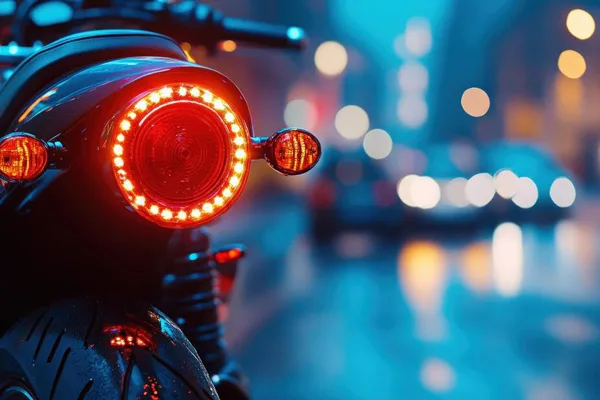
Plastic motorcycle lights
2. Material Innovation: The Foundation of Process Evolution
PA46 (Polyamide 46):
PA46, is a high-performance polyamide characterized by a high melting point (295 °C) and a high glass transition temperature. Its crystalline structure provides outstanding mechanical properties even at temperatures up to 220 °C, making it suitable for under‑hood applications where conventional nylons would soften or creep. The material’s excellent fatigue resistance and low coefficient of friction allow injection‑molded cam gears to operate with minimal wear and reduced noise compared to steel counterparts. Additionally, PA46 resists oils, greases, and automotive fluids, ensuring long‑term reliability in the harsh engine environment. Its high flowability during injection molding enables the production of thin‑wall, complex components with high precision. Outside of cam gears and thrust washers, PA46 is also used in turbocharger actuators, chain tensioners and electrical connectors that require both thermal stability and structural integrity.
PC/ABS (Polycarbonate/Acrylonitrile Butadiene Styrene) Blends:
PC/ABS blends marry the high impact resistance and dimensional stability of polycarbonate with the flowability and surface aesthetics of ABS. The result is a material that can withstand significant mechanical stress—ideal for battery housings that must resist road debris and potential impacts—while maintaining a high‑quality appearance suitable for visible interior and exterior components. These blends can be formulated with UV stabilizers to resist yellowing and degradation from prolonged sun exposure, which is critical for motorcycle applications where components are often exposed to direct sunlight. PC/ABS also offers good heat deflection temperatures (typically 100–120 °C) and excellent plating and painting adhesion, allowing decorative chrome finishes on parts like mirror housings or instrument bezels. In electric motorcycles, PC/ABS is frequently used for high‑voltage battery enclosures because of its combination of electrical insulation, mechanical strength, and flame‑retardant variants (UL94 V‑0 rated) that meet safety standards.
Polypropylene (PP)
Polypropylene is the most widely used commodity plastic in motorcycles due to its low density, excellent chemical resistance and low cost. It is often reinforced with talc or glass fibers to increase stiffness and heat deflection temperature. Typical applications include underbody fairings, splash guards, battery trays, air filter housing, and side covers where high impact resistance is required but extreme temperatures are not encountered. PP also offers good fatigue resistance, making it suitable for hinged components such as glove boxes or fuel filler flaps. Its recyclability aligns with sustainability goals, and post‑industrial recycled PP is increasingly used for non‑visible structural parts.
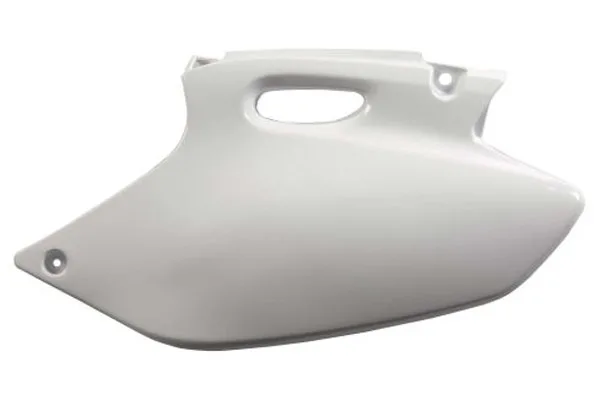
Moto side panel
TPU (Thermoplastic Polyurethane) Combined with Metal or Rigid Plastic:
Thermoplastic polyurethane (TPU) is a versatile elastomer that combines rubber‑like flexibility with the processability of thermoplastics. Its hardness can be tuned from Shore 60A to Shore 75D. In motorcycle manufacturing, TPU is most valuable when overmolded onto a rigid substrate—either metal or a hard plastic like nylon or polycarbonate—using two‑shot injection molding or insert molding. This creates components with integrated soft‑touch surfaces that absorb vibration, improve grip, and enhance rider comfort. Examples include handlebar grips, foot pegs, seat pans with integrated comfort layers, and vibration‑damping mounts for electronic components. TPU also exhibits excellent abrasion resistance, making it ideal for areas prone to wear, such as tank pads and chain guards. Its resistance to oils, fuels, and weathering ensures durability in outdoor environments. Advanced multi‑material molding techniques allow for seamless integration of seals and gaskets directly into housings, eliminating secondary assembly and reducing potential leak paths.
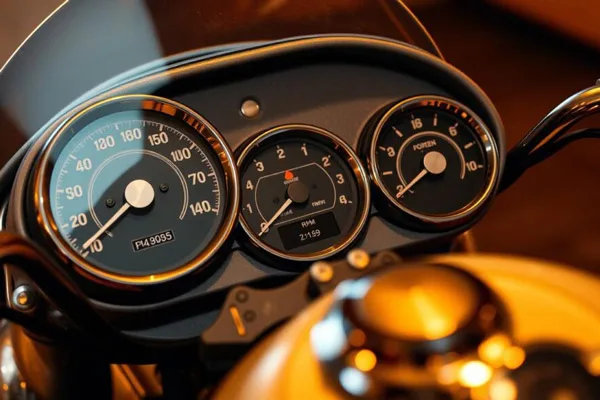
Moto instrument panels
POM (Polyoxymethylene):
Polyoxymethylene (POM), often referred to as acetal, is a high‑crystallinity engineering plastic prized for its low coefficient of friction, high stiffness, and excellent dimensional stability. Its self‑lubricating nature makes it ideal for sliding applications such as gear shift linkages, throttle cable guides, speedometer drive gears, and seat latch mechanisms—where metal‑to‑metal contact would require lubrication and would be prone to wear. POM also offers good chemical resistance to fuels, solvents, and common automotive fluids, ensuring reliability in under‑hood and chassis environments. Because it absorbs very little moisture, the parts maintain tight tolerances under varying humidity conditions, which is critical for the precision mechanism. For injection molding, POM’s rapid crystallization allows short cycle times, contributing to cost‑effective mass production. In addition to moving parts, POM is used in fuel system components such as pump housing and float level sensors, where low swelling and fuel resistance are required.
3. Surface Finishing Processes in Motorcycle Plastic Components
|
Process |
Description |
Motorcycle Applications |
Advantages |
| Spray Painting | Multi-layer application (primer, basecoat, clearcoat) to form a protective and decorative coating. | Fairings, fenders, side covers, fuel tank trim panels, and other visible exterior parts. | Plastic parts require surface pretreatment (flame, corona, or primer) for adhesion; PP needs a special primer. Robotic applicators with electrostatic bells ensure high transfer efficiency, while water‑based paints are used on premium models for reduced environmental impact. |
| In‑Mold Decoration (IMD) | Decorative film or label is placed in the mold before injection; the decoration becomes integral with the molded part. | Instrument panels, brand emblems, function key panels, decorative trim strips. | Eliminates secondary painting, reduces environmental impact, and increases production efficiency. Provides high wear and chemical resistance; patterns will not peel or fade. |
| Vacuum Metallization | Metal is evaporated and deposited onto the plastic surface in a vacuum chamber; usually requires base coat and top coat. | Headlight reflectors, turn signal reflectors, instrument cluster bezels, front grille trim, mirror housings. | Commonly used substrates: PC and ABS. Requires excellent surface quality on the molded part—any flow marks or sink marks become highly visible after metallization. |
| Hot Stamping | Heat and pressure transfer a metallic or colored foil pattern onto the plastic surface. | Brand logos, function symbols on switch panels, decorative accent lines. | Often used for small parts or localized decoration. Provides sharp, durable markings. |
| Water Transfer Printing | A water-soluble film carrying a pattern is floated on water; an activator softens the pattern, and the part is immersed to wrap the pattern around its surface. | Simulated carbon fiber, wood grain, camouflage patterns; used on instrument covers, inner panels, small fairing parts. | Ideal for complex curved surfaces, enabling seamless one‑piece decoration. |
4. Process Advancements: Toward Intelligence and Precision
Precision Mold Design
For components with complex geometries, such as intake manifolds with side holes and angled bores, molds now incorporate sophisticated mechanisms like secondary core‑pulling systems. These solve traditional demolding challenges and ensure high precision in a single molding cycle.
High‑Quality Surface Finishing
For parts requiring excellent optical clarity and surface appearance—like headlight lenses and transparent instrument covers—hot runner systems have become standard. By precisely controlling melt temperature and filling dynamics, hot runners eliminate cold‑runner waste, reduce weld lines and flow marks, and ensure superior transparency and surface gloss.
Intelligent Production
Large‑scale motorcycle manufacturers are undergoing a profound digital transformation in their injection molding workshops. By integrating automated robotic arms for material handling and implementing proprietary production planning and scheduling systems, they have achieved end‑to‑end digital monitoring and traceability—from raw material intake, through injection molding, to final product output. This intelligent approach not only significantly reduces labor costs but also lowers overall production costs while steadily improving first‑pass yield rates. It provides a robust foundation for high‑volume, consistent‑quality manufacturing.
In addition, the adoption of Industry 4.0 principles enables predictive maintenance and real-time process adjustments, minimizing downtime and scrap rates. Data analytics-driven quality control systems are now capable of identifying potential defects early in the production cycle, further improving product reliability.
5. Conclusion: Future Outlook
The application of plastic injection molding in motorcycle manufacturing is moving steadily toward lighter weight, higher strength, greater intelligence, and superior aesthetics. With the rise of electrification and the increasing sophistication of vehicle intelligence, the demand for lightweight structural components, battery pack enclosures, sensor housings, and advanced human‑machine interfaces will only intensify. This will drive deeper integration of injection molding with new composite materials (such as carbon‑fiber‑reinforced plastics), additive manufacturing (3D printing), and the Internet of Things (IoT).
As the critical bridge linking design concepts to final production, plastic injection molding will continue to play a pivotal role in the innovation journey of the motorcycle industry, propelling the development of higher‑performance, better‑experiencing, and more sustainable vehicles.