
Silicone 3D printing has revolutionized the way engineers and manufacturers approach the creation of flexible, durable, and high-performance prototypes and end-use parts. As the technology advances, a key question arises: should you use real silicone or opt for elastomeric alternatives? This article provides a comprehensive overview of silicone 3D printing, comparing the benefits, limitations, and applications of real silicone versus elastomeric options.
Understanding Silicone 3D Printing
Silicone 3D printing involves creating three-dimensional objects using silicone-based materials through additive manufacturing processes. This technology enables rapid prototyping, custom manufacturing, and complex geometries that traditional silicone molding methods might find challenging or costly to produce.
For decades, silicone has been the material of choice for applications requiring flexibility, heat resistance, chemical stability, and biocompatibility—from medical implants and wearable devices to automotive seals and aerospace components. Yet for all its virtues, silicone has historically been notoriously difficult to 3D print.
Real Silicone in 3D Printing
What Is Real Silicone?
Real silicone refers to materials that are chemically identical or highly similar to traditional silicone elastomers used in manufacturing. These materials typically exhibit excellent flexibility, thermal stability, chemical resistance, and biocompatibility.
Advantages of Using Real Silicone
Authentic Material Properties: Maintains the same flexibility, elasticity, and durability as conventionally manufactured silicone parts.
Biocompatibility: Suitable for medical applications, including implants and prosthetics.
Chemical and Temperature Resistance: Handles harsh environments without degrading.
Precision and Detail: Capable of capturing intricate features and fine details in 3D printed parts.
Limitations
Cost: Real silicone materials tend to be more expensive than alternatives.
Processing Challenges: Often requires specialized equipment and handling procedures.
Limited Material Options: Fewer formulations are available compared to other elastomers, restricting customization.
Elastomeric Alternatives
What Are Elastomeric Alternatives?
Elastomeric alternatives encompass a broad range of flexible polymers that are not chemically identical to silicone but offer similar elastic properties. Common materials include polyurethane, thermoplastic elastomers (TPE), and other flexible resins compatible with various 3D printing technologies.
Thermoplastic Polyurethane (TPU)
TPU is the most common flexible material in 3D printing, widely used in FDM and powder bed fusion (SLS) processes. It is a thermoplastic elastomer that combines the elasticity of rubber with the processability of thermoplastics.
- Shore Hardness: TPU typically ranges from 60–100 Shore A, which is generally harder than most silicone formulations.
- Wear Resistance: TPU offers excellent abrasion resistance, often outperforming silicone in this regard.
- Fatigue Performance: Some studies have shown that 3D‑printed TPU actuators can withstand more fatigue cycles than silicone actuators—averaging 6,410 cycles at 3 bar pressure compared to 3,439 cycles for silicone.
- Processing: TPU can be processed on standard FDM printers with minimal modifications.
Limitations: TPU lacks the extreme temperature resistance, chemical resistance, and biocompatibility of true silicone. It is not suitable for high‑temperature applications or prolonged contact with aggressive chemicals.
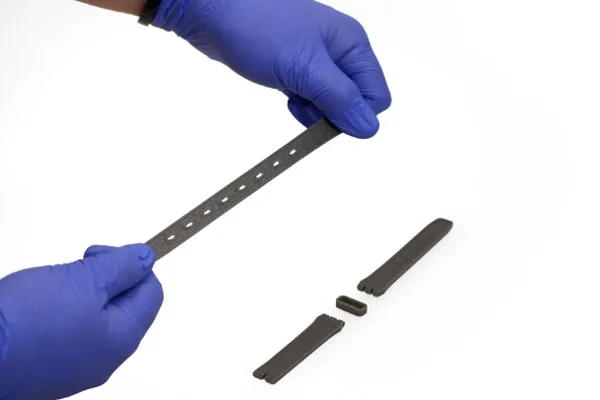
Silicone band
Thermoplastic Elastomers (TPE)
TPE is a broader class of materials that includes TPU as well as other elastomer‑thermoplastic blends. General‑purpose TPE filaments are typically softer and more rubber‑like than TPU, making them ideal for applications needing high conformity, like soft grips or child‑safe products. However, they generally have lower tensile strength and wear resistance compared to TPU.
Photopolymer Elastomers
For vat photopolymerization technologies like SLA and DLP, a range of “elastic” or “flexible” resins are available. These are UV‑curable photopolymers formulated to mimic the feel and flexibility of rubber or silicone.
- Shore Hardness: These materials can range from 30A to 95A.
- Surface Finish: DLP and SLA processes typically produce smooth surface finishes with no visible layers.
Limitations: These UV‑cured elastomers generally have lower tear strength and will break at lower elongations compared to normal silicone. They also lack the long‑term thermal and chemical stability of true silicone.
Carbon DLS Elastomers
Carbon’s Digital Light Synthesis (DLS) technology offers elastomeric polyurethane (EPU) materials used in production applications. These materials are engineered for high performance but remain chemically distinct from silicone.
Advantages
- Cost-Effective: Generally more affordable than real silicone materials.
- Ease of Processing: Compatible with common 3D printing methods like FDM, SLA, or DLP.
- Variety of Properties: Can be tailored for specific applications, including UV resistance, enhanced toughness, or chemical resistance.
- Faster Production: Often have shorter curing times and simpler handling.
Limitations
- Material Behavior: May not match true silicone’s flexibility or temperature resistance.
- Durability: Some alternatives might degrade faster under specific conditions.
- Biocompatibility: Not always suitable for medical or skin-contact applications.
Comparing Real Silicone and Elastomeric Alternatives
|
Feature |
Real Silicone |
Elastomeric Alternatives |
| Material Authenticity | Chemically identical to traditional silicone | Different polymers with similar elasticity |
| Cost | Higher | Lower |
| Processing Complexity | More specialized equipment | More versatile and accessible |
| Mechanical Properties | Excellent flexibility, thermal stability | Varies; can be tailored but may not match silicone perfectly |
| Applications | Medical, high-temperature, chemically resistant | General prototyping, consumer products, flexible fixtures |
| Environmental Resistance | Superior in harsh environments | Good, but varies by material |
Applications and Use Cases
Medical and Healthcare
Patient‑Specific Models: 3D‑printed silicone anatomical models offer exceptional haptics and accuracy, reducing reliance on cadaver or animal trials. High‑fidelity models for surgical planning are being created using AI‑driven 3D reconstruction and silicone printing.
Personalized Implants: 3D printing is enabling patient‑specific soft tissue implants and prosthetics.
Prosthetics and Orthotics: Custom‑fit prosthetics, hearing aids, and orthotic devices can be produced without tooling.
Wearables: Silicone’s biocompatibility and flexibility make it ideal for wearable health monitors, CPAP masks, and skin‑contact devices.
Artificial Organs: Researchers are even 3D printing components like artificial aortic heart valves using UV‑cured silicone.
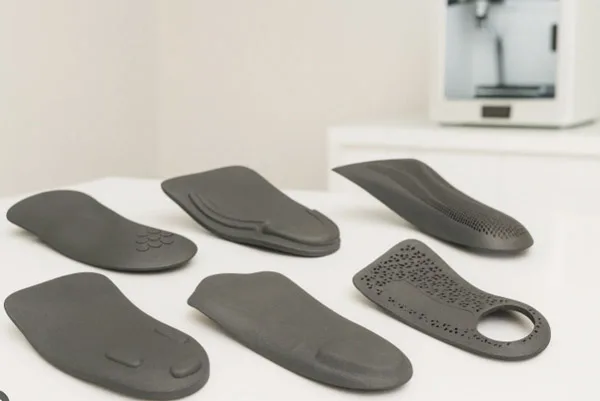
3D printing orthotics
Automotive and Industrial
Silicone’s heat resistance and chemical stability make it essential for automotive seals, gaskets, covers, dampers, and protective parts. The tool‑free nature of 3D printing allows for rapid iteration and on‑demand production of custom components. P3™ Silicone 25A has been validated in thermal aging tests up to 1,000 hours at 150°C, demonstrating its suitability for demanding automotive environments.
Aerospace and Defense
High‑performance parts such as fire‑resistant seals, conductive components, and personal protective equipment are now achievable with advanced silicone 3D printing technologies like Dynamic Molding. These applications demand the thermal stability and chemical resistance that only true silicone can provide.
Soft Robotics
Silicone inks have enabled the fabrication of robotic actuators and grippers. The ability to 3D print complex, compliant structures with precisely tuned mechanical properties is opening new possibilities in soft robotics.
Consumer Goods
Elastomeric alternatives excel in consumer applications where the “feel” of rubber is desired but extreme performance isn’t required—shoe soles, phone cases, grips, and wearable accessories.
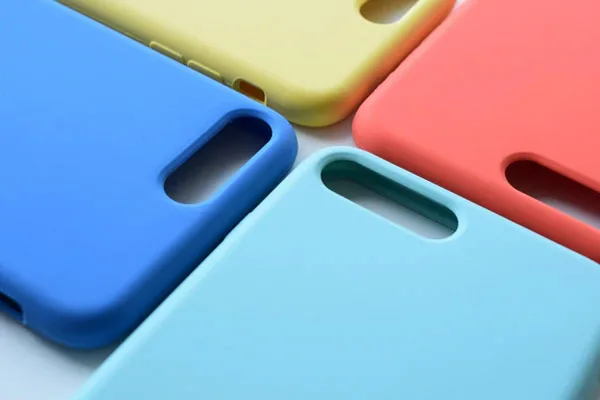
Silicone phone cases
When to Choose Real Silicone
Extreme temperature resistance
Superior chemical resistance
Proven biocompatibility for medical or skin‑contact applications
Long‑term durability in demanding environments
Very soft durometers
High tear strength and elongation at break
Regulatory compliance for medical, food contact, or aerospace applications
End‑use production in low to medium volumes where molding is not cost‑effective
When to Choose Elastomeric Alternatives
Cost is a primary concern and performance requirements are modest
You have existing FDM or SLA/DLP equipment and want to avoid capital investment
Production volumes are very low and the part does not need to withstand extreme conditions
The application involves cyclic loading where TPU’s fatigue resistance may be advantageous
Rapid prototyping is needed and the part will not be used in production
Higher hardness is acceptable or desirable
Quick iteration is more important than long‑term material stability
Future Trends in Silicone 3D Printing
Advancements in material science and printing technologies continue to expand the possibilities for silicone and elastomeric 3D printing. Researchers are working on developing more affordable, high-performance silicone-like materials suitable for additive manufacturing, which could bridge the gap between authenticity and practicality.
Conclusion
Both real silicone and elastomeric alternatives have their place in the world of 3D printing. Understanding their differences allows engineers and designers to make informed decisions tailored to their project needs, balancing factors such as cost, performance, and processing complexity. As technology progresses, the line between these materials will likely continue to blur, offering even more options for innovative applications.