
Additive Manufacturing (AM), commonly known as 3D printing, has emerged as a groundbreaking technology with the potential to revolutionize various industries. Among these, the aerospace sector stands out as one of the most significantly impacted, experiencing transformative changes that enhance performance, reduce costs, and foster innovation. This article explores how additive manufacturing is reshaping the aerospace industry and the promising future it holds.
The Evolution of Additive Manufacturing in Aerospace
Traditionally, aerospace components were manufactured using subtractive methods such as machining, casting, and forging. These processes often involved lengthy lead times, high material wastage, and limitations in design complexity. The advent of additive manufacturing has introduced a paradigm shift, enabling the production of complex geometries that were previously impossible or impractical to achieve.
The aerospace industry has been quick to adopt AM, recognizing its potential to streamline production, improve component performance, and reduce weight — all critical factors in aerospace engineering.
Key Benefits of Additive Manufacturing in Aerospace
Weight Reduction and Performance Enhancement
One of the most significant advantages of AM is the ability to produce lightweight structures through intricate lattice and topology optimization. Reduced weight translates directly into fuel savings and increased payload capacity, making flights more efficient and cost-effective.
Design Flexibility and Innovation
Additive manufacturing allows for complex geometries, such as internal channels, conformal cooling, and integrated parts, which are difficult or impossible to manufacture with traditional methods. This opens up new avenues for innovative designs that enhance aerodynamics, thermal management, and structural integrity.
Rapid Prototyping and Shorter Lead Times
AM accelerates the development cycle by enabling rapid prototyping of parts. Engineers can iterate designs quickly, test prototypes, and move to production faster, reducing time-to-market for new aerospace technologies.
Reduction in Material Waste and Cost
Traditional manufacturing often results in significant material waste. In contrast, additive manufacturing builds parts layer-by-layer, using only the material necessary, leading to cost savings and more sustainable practices.
On-Demand Spare Parts and Maintenance
AM facilitates the production of spare parts on demand, even for obsolete components. This capability reduces inventory costs, minimizes downtime, and enhances maintenance efficiency, especially in remote or hard-to-reach locations like space stations or aircraft on long-haul routes.
Notable Applications of Additive Manufacturing in Aerospace
- Engine Components: Companies like GE and Rolls-Royce are utilizing AM to produce fuel nozzles, turbine blades, and other engine parts that benefit from weight reduction and enhanced thermal properties.
- Structural Parts: Airbus and Boeing are exploring AM for constructing fuselage brackets, interior components, and structural supports, leading to lighter aircraft and improved fuel efficiency.
- Customized and Complex Parts: AM allows for the creation of customized solutions tailored to specific aircraft models or mission requirements, facilitating greater adaptability.
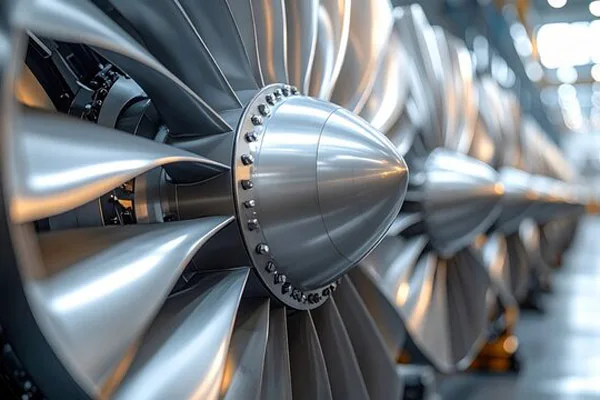
Aerospace parts
Primary Materials Used in Aerospace 3D Printing
When it comes to printing parts for flight, the material must match the mission. Inside the fiery core of the engine and across the aircraft’s main skeleton, tough metals like titanium and aluminum are the undisputed champions, braving extreme temperatures and immense physical stress without faltering. Move into the passenger cabin, and the chemistry changes: high-performance polymers take over, prized not for their muscle, but for their ability to smother flames and keep the air pure by releasing minimal vapor. Bridging the gap are thermoplastic composites—the ultimate weight-saving allies. They deliver exceptional stiffness for their mass, making them essential for engineers who must rigorously slash weight while never compromising on safety margins.
Key Manufacturing Processes for Aerospace 3D Printing
Aerospace 3D printing involves a range of additive manufacturing techniques, including methods like Stereolithography (SLA) and Selective Laser Sintering (SLS), which are commonly used to produce highly detailed parts with precise accuracy.
Other prominent processes include:
- Direct Metal Laser Sintering (DMLS): Extensively used for fabricating strong, durable metal components that meet the high-performance standards of aerospace applications.
- Fused Deposition Modeling (FDM): Ideal for rapid prototyping of larger, robust parts, often utilized in aerospace testing and development.
- Powder Bed Fusion Technologies: Such as SLS for polymers and DMLS for metals, which enable the production of complex, high-strength functional parts with intricate geometries.
- Emerging Technologies: Pellet-based additive manufacturing offers faster build speeds for large-scale parts, while material jetting allows for multi-color and multi-material prototypes, enhancing both visualization and functional testing of innovative designs.
Beyond Prototyping: The Manufacturing Workflow Revolution
While rapid prototyping remains a core strength, the true transformation lies in the complete reimagining of the manufacturing workflow. Additive manufacturing enables consolidation of assemblies, where dozens of individual fasteners, brackets, and fittings are integrated into a single, monolithic printed structure. This reduces not just the part count, but also the weight associated with fasteners and the time required for assembly. Furthermore, AM is enabling parts with gradient properties, where a single component can be printed with varying material densities or alloys to meet differing stress requirements at different points. This eliminates the need for welding or joining dissimilar materials, creating a seamless transition that improves both structural performance and fatigue resistance.
Challenges and Future Outlook
Despite its advantages, additive manufacturing in aerospace faces challenges such as ensuring consistent quality, certification standards, and material limitations. Achieving regulatory approval for safety-critical components remains a complex process, requiring rigorous testing and validation.
However, ongoing research, advancements in materials, and the development of industry standards are paving the way for broader adoption. The integration of AM with other emerging technologies like artificial intelligence and digital twins promises to further optimize manufacturing processes and enhance design capabilities.
Conclusion
Additive manufacturing is undeniably transforming the aerospace industry by enabling lighter, stronger, and more innovative components while reducing costs and lead times. As technology continues to evolve, its influence is expected to grow, driving the development of more efficient, sustainable, and resilient aerospace systems. The future of aerospace manufacturing is poised to be shaped significantly by the continued integration of 3D printing technologies, opening new horizons for exploration, travel, and innovation.