
In the rapidly evolving world of manufacturing and industrial engineering, additive manufacturing (AM) has revolutionized the way products are designed, prototyped, and produced. Among the various AM technologies, Selective Laser Sintering (SLS) stands out as a highly versatile and powerful method capable of producing complex, high-performance parts with precision and efficiency. This comprehensive guide explores SLS 3D printing from an industrial engineering perspective, covering its principles, advantages, applications, and best practices.
What is Selective Laser Sintering (SLS)?
Selective Laser Sintering is an additive manufacturing process that uses a high-powered laser to fuse powdered materials layer by layer to create solid, functional parts. Unlike traditional subtractive manufacturing, which involves cutting away material, SLS builds parts directly from digital models, enabling complex geometries and rapid iteration.
Basic Process Overview:
1. Preparation: A thin layer of powdered material—typically plastic, metal, or ceramic—is spread evenly over the build platform.
2. Laser Sintering: A computer-controlled laser scans the cross-section of the part, selectively fusing powder particles together.
3. Layering: The build platform lowers, and a new layer of powder is spread over the previous one.
4. Repetition: The process repeats layer by layer until the entire part is formed.
5. Post-Processing: The built part is removed, cooled, and undergoes finishing processes like cleaning, support removal, and surface treatment.
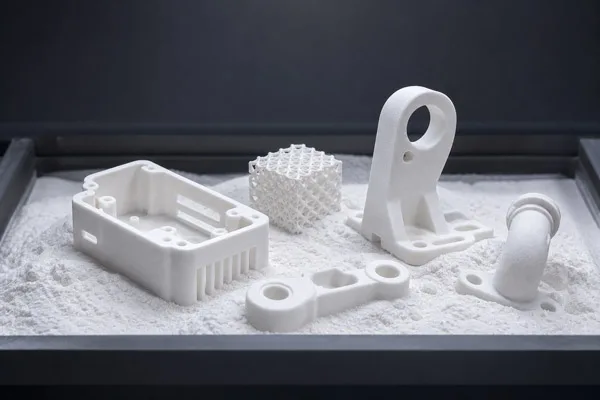
SLS printing
Key Materials Used in SLS
SLS technology supports a broad range of materials, making it adaptable for various industrial applications:
- Polyamides (Nylon): The most common material, offering flexibility, durability, and chemical resistance.
- Thermoplastic Composites: Nylon infused with carbon fiber, glass fiber, or other reinforcements for enhanced strength and stiffness.
- Metals: Specialized SLS systems can process metal powders such as stainless steel, aluminum, and titanium.
- Ceramics: For high-temperature and wear-resistant applications.
Advantages of SLS in Industrial Engineering
Complex Geometries
One of the most significant advantages of SLS is its ability to produce intricate designs that would be impossible or prohibitively expensive with traditional manufacturing methods such as injection molding or CNC machining. Internal channels, lattice structures, and organic shapes are all achievable without specialized tooling.
Rapid Prototyping
SLS dramatically accelerates product development cycles by offering quick turnaround times from CAD file to physical part. Engineers can iterate designs daily rather than weekly, compressing months of development into weeks.
Functional Parts
Unlike many 3D printing technologies that produce only visual prototypes, SLS is suitable for end-use components, especially when using high-performance materials such as glass-filled nylon, carbon-fiber-reinforced composites, or flexible TPU. These parts withstand mechanical stress, temperature extremes, and chemical exposure.
No Need for Support Structures
Because the unsintered powder bed acts as a natural support material, SLS eliminates the need for sacrificial supports. Overhangs, undercuts, hollow cavities, and even interlocking moving assemblies can be printed without any additional design features for support attachment or removal.
Material Efficiency
SLS is remarkably material-efficient. Excess powder that is not sintered during the build can often be reclaimed, sieved, and reused in future builds. This closed-loop approach reduces raw material waste to a fraction of what subtractive methods generate.
Customization
SLS excels at low-volume production, customized parts, and small-batch manufacturing. Since there is no tooling cost per unique design, each part can be different from the next at no additional setup expense—enabling true mass customization.
Industrial Applications of SLS
Aerospace
In the aerospace sector, SLS technology is used to produce lightweight structural components that reduce overall vehicle mass, complex ducting and fluid management parts with internal geometries impossible to machine conventionally, and custom tooling and jigs that streamline assembly and maintenance operations.
Automotive
The automotive industry leverages SLS for prototype parts and functional components that undergo rigorous testing, custom interior fixtures that enhance driver and passenger experience, and lightweight brackets and housings that contribute to overall vehicle efficiency.
Medical
Medical applications of SLS include customized prosthetics and implants tailored to individual patient anatomy, surgical guides that improve procedure accuracy and outcomes, and dental devices such as aligners, crowns, and surgical stents.
Consumer Products
Within consumer goods, SLS enables the creation of artistic and fashion items that push design boundaries, customized accessories ranging from eyewear to footwear, and functional prototypes that accelerate product development cycles.
Manufacturing and Tooling
In general manufacturing and tooling, SLS produces manufacturing aids and fixtures that improve production line efficiency, as well as end-use tooling for injection molding or casting processes, including grippers, conformal cooling inserts, and low-volume mold cavities.
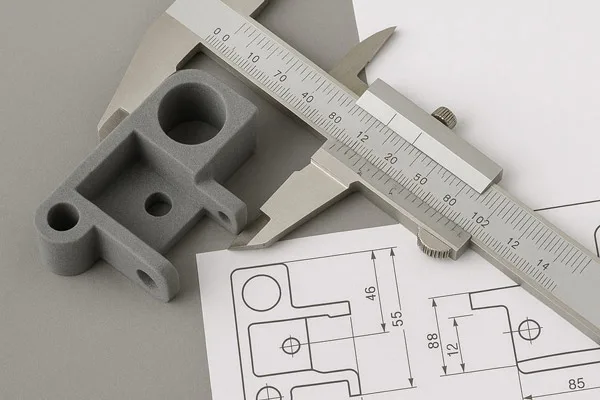
SLS 3D Printing part
Best Practices for Optimizing SLS Processes
Thoughtful Material Selection
Choosing the right material is fundamental to achieving optimal results. Engineers should consider the specific requirements of each application, such as mechanical strength, flexibility, impact resistance, and temperature tolerance. For example, nylon-based powders are ideal for lightweight, durable parts, while reinforced composites like carbon fiber-infused nylons provide higher stiffness and strength. Cost considerations also play a role; selecting materials that balance performance with affordability can significantly reduce overall production expenses. Staying updated with emerging materials can open new possibilities for specialized applications.
Design Optimization for Additive Manufacturing
Designing parts with manufacturing in mind is critical for success in SLS. Engineers should aim to create geometries that facilitate efficient printing and post-processing. This includes selecting appropriate wall thicknesses—thick enough to ensure structural integrity but not so thick as to increase print time unnecessarily. Minimizing unsupported overhangs reduces the need for support structures, which can be time-consuming to remove and may affect surface quality. Incorporating features like chamfers, fillets, and self-supporting angles helps improve printability and reduces post-processing efforts. Additionally, designing parts with modularity or considering assembly methods can further streamline production.
Precise Parameter Calibration and Control
Consistent quality depends heavily on carefully calibrated machine parameters. Regular calibration sessions ensure that laser power, scan speed, layer thickness, and recoating speeds are optimized for the chosen material and part geometry. Implementing automated calibration routines and real-time monitoring systems can detect deviations early, allowing for prompt adjustments. Fine-tuning these parameters reduces defects such as warping, incomplete fusion, or porosity, leading to stronger, more reliable parts.
Supportless Design and Use of Powder Bed as Support
One of the distinctive advantages of SLS is that the powder bed itself acts as a support medium, eliminating the need for additional support structures in most cases. Designing parts to leverage this feature simplifies post-processing and reduces material waste. Engineers should consider self-supporting angles and overhangs within the design constraints, ensuring that the entire part can be built without resorting to supports. This approach not only saves time but also improves surface finish quality, as removing supports often leaves marks or surface imperfections.
Effective Post-Processing Techniques
While SLS parts often have good dimensional accuracy straight from the build, post-processing is essential to achieve the desired surface quality and functional properties. Techniques such as tumbling, sanding, vapor polishing, or applying coatings can smooth surfaces, remove residual powder, and improve aesthetic appeal. For parts requiring high precision or specific surface finishes, additional machining or infiltration processes might be necessary. Developing a standardized post-processing protocol tailored to each material and application ensures consistency and quality.
Efficient Powder Recycling and Material Management
Maximizing material efficiency is vital for cost control. Unused or excess powder can often be reclaimed and reused in subsequent builds, but it’s important to monitor powder quality carefully. Over multiple reuse cycles, powder may degrade or accumulate contaminants, affecting part quality. Regular sieving, filtering, and testing help maintain powder integrity. Establishing a clear powder management strategy minimizes waste, reduces material costs, and promotes sustainable manufacturing practices.
Rigorous Quality Control and Inspection
Implementing comprehensive quality control measures is crucial for ensuring that parts meet specifications. Non-destructive testing methods such as CT scanning, ultrasonic inspection, or laser scanning can verify internal structures and dimensional accuracy without damaging the parts. Routine inspection during and after production helps detect defects early, reducing rework and scrap rates. Maintaining detailed process records and inspection logs supports continuous improvement initiatives and compliance with industry standards.
Future Trends in SLS and Industrial Engineering
The future of SLS in industrial engineering is promising, with ongoing advancements including:
- Material Development: New composite materials with enhanced properties for demanding applications.
- Process Automation: Integration of AI and machine learning for real-time process optimization.
- Larger Build Volumes: Development of bigger machines for larger parts or batch production.
- Hybrid Manufacturing: Combining SLS with subtractive methods for complex, high-precision components.
- Cost Reduction: Innovations aimed at lowering material and equipment costs.
Conclusion
Selective Laser Sintering (SLS) stands as a transformative technology within industrial engineering, offering unparalleled design flexibility, rapid prototyping capabilities, and functional production parts. By understanding its principles, materials, applications, and best practices, engineers can leverage SLS to accelerate innovation, reduce costs, and create complex geometries that push the boundaries of traditional manufacturing.
As the technology continues to evolve, embracing SLS can provide a competitive edge in a dynamic manufacturing landscape, enabling industries to meet the demands of customization, speed, and performance with efficiency and precision.