
Polycarbonate (PC) injection molding is a widely used manufacturing process known for its ability to produce high-quality, durable, and complex plastic parts. Renowned for its excellent impact resistance, optical clarity, and heat resistance, polycarbonate is a versatile thermoplastic material that finds applications across various industries, including automotive, electronics, medical devices, and consumer goods. This comprehensive guide aims to provide an in-depth understanding of polycarbonate injection molding, covering material properties, the injection molding process, and key design considerations to optimize manufacturing outcomes.

Polycarbonate
1. Understanding Polycarbonate (PC) Material
Properties of Polycarbonate
Polycarbonate is a high-performance thermoplastic characterized by its unique combination of strength, transparency, and thermal stability. Some of its key properties include:
Impact Resistance: PC exhibits exceptional toughness, making it resistant to cracking and breaking under impact.
Optical Clarity: It is highly transparent, comparable to glass, making it suitable for applications requiring clarity.
Heat Resistance: PC maintains its mechanical properties at elevated temperatures, with a glass transition temperature around 147°C.
Dimensional Stability: It offers good dimensional stability, ensuring precision in molded parts.
Chemical Resistance: PC resists many chemicals, although it can be susceptible to certain solvents and acids.
Ease of Processing: It can be readily molded into complex shapes using injection molding techniques.
Common Grades and Additives
Polycarbonate materials come in various grades tailored for specific applications, including:
Standard PC: General-purpose applications, good impact resistance and clarity.
UV-Resistant PC: Suitable for outdoor applications, includes UV stabilizers.
Flame-Retardant PC: Contains flame-retardant additives for safety-critical parts.
Medical-Grade PC: Meets biocompatibility and sterilization standards.

PC raw materials
2. Injection Molding Process for Polycarbonate
Step-by-Step Overview
The injection molding process for polycarbonate involves several precise steps to ensure quality and consistency:
1. Material Preparation: Raw polycarbonate pellets are dried typically at 80–120°C for 2–4 hours to remove moisture, which can cause defects like splay or bubbles.
2. Melting: The dried pellets are fed into an injection molding machine. The material is heated to a melt temperature of approximately 270–310°C.
3. Injection: The molten polycarbonate is injected into a meticulously designed mold cavity under high pressure to fill all features.
4. Cooling: The mold is cooled, often using water channels, to solidify the part. Proper cooling is essential to prevent warping or internal stresses.
5. Ejection: Once cooled, the mold opens, and the finished part is ejected carefully to avoid damage.
6. Post-Processing: Additional steps like trimming, finishing, or surface treatments may be performed.
Processing Parameters
Temperature: Barrel temperatures typically range from 270°C to 310°C.
Injection Pressure: Usually between 80–150 MPa, depending on part complexity.
Cooling Time: Varies based on wall thickness; generally 10–30 seconds.
Drying: Critical for preventing defects, with specific parameters depending on the moisture content of the material.
3. Design Considerations for Polycarbonate Injection Molding
Designing parts for polycarbonate injection molding requires careful attention to several factors to optimize manufacturability, performance, and cost:
Wall Thickness
Maintain uniform wall thickness, ideally around 1.5–3 mm, to ensure even cooling and reduce warping.
Avoid abrupt changes in thickness; use gradual transitions.
Draft Angles
Incorporate draft angles of 1–2° to facilitate part ejection and reduce surface scratching.
Ribs and Bosses
Ribs should be adequately thick to provide strength without causing sink marks.
Bosses for inserts or fasteners should be designed with sufficient wall thickness and fillets.
Gate Location and Type
Place gates at the thickest sections for better flow.
Use hot runner systems for precise control and reduced waste.
Surface Finish
Achieve desired surface quality through mold polishing or texturing.
Consider UV resistance or other surface treatments if needed.
Shrinkage Compensation
Account for typical polycarbonate shrinkage (~0.5–0.7%) in mold design to achieve accurate dimensions.
Venting and Cooling
Proper venting prevents burn marks and trapped air.
Optimize cooling channels to reduce cycle times and improve part quality.
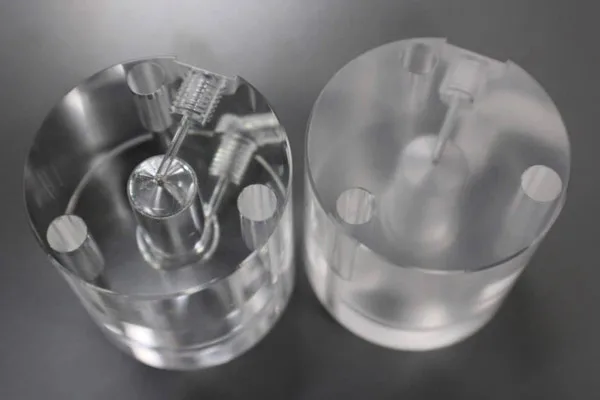
Polishing plastic
4. Challenges and Solutions in PC Injection Molding
While polycarbonate offers many advantages, certain challenges can arise:
Moisture Absorption: Can cause splay or bubbles. Solution: proper drying.
Warping and Warpage: Due to uneven cooling. Solution: uniform wall thickness and optimized cooling.
Flow Lines and Knit Lines: Result from improper flow. Solution: mold design optimization and process control.
Brittle Fracture or Stress Cracking: Due to residual stresses. Solution: proper mold temperature control and annealing post-molding.
5. Applications of Polycarbonate Injection-Molded Parts
Polycarbonate’s unique properties make it ideal for a wide range of applications:
- Automotive Components: Headlamp lenses, interior parts.
- Electronics: Housings, connectors, display screens.
- Medical Devices: Syringes, medical housings, sterilizable parts.
- Consumer Goods: Eyewear lenses, protective cases, sporting equipment.
- Optical Media: CDs, DVDs, Blu-ray discs.

Syringes
6. Conclusion
Polycarbonate injection molding is a powerful manufacturing method capable of producing high-quality, durable, and complex parts suitable for demanding applications. Success in processing polycarbonate depends on understanding its material properties, optimizing process parameters, and designing parts with manufacturability in mind. By adhering to best practices and considering the specific needs of polycarbonate, manufacturers can leverage its full potential to create innovative and reliable products across various industries.
For optimal results, partnering with experienced mold designers and process engineers is recommended to navigate the nuances of polycarbonate injection molding and ensure high-quality production.