
Plastic injection molding is a highly accurate manufacturing process used to produce complex plastic parts with high efficiency and consistency. It is widely employed across industries, from automotive and consumer electronics to medical devices and packaging. At the heart of this process lies a fundamental factor that directly affects the quality, accuracy and efficiency of the final product: temperature management.
Proper temperature control is not just a technical detail; This is an essential aspect that determines the success or failure of an injection molding operation. It influences every stage of the process, from material flow to final part quality, making it a critical parameter that cannot be overlooked.
To fully appreciate its significance, one must understand that injection molding is fundamentally a thermal process. It relies on the precise manipulation of heat to transform solid polymer pellets into a fluid state, inject them into a cooler mold, and then remove that heat to solidify the part. Every transition the material undergoes is driven by a temperature gradient. If these gradients are not carefully controlled and predicted, the whole process becomes unstable. This is why temperature management is not just a set-up on a machine. It is the fundamental science upon which successful shaping is built.
Why is Temperature Control Crucial?
1. Ensures Material Flow and Fillability
The flow of molten plastic into the mold cavity depends heavily on temperature. The polymer must reach a specific melt temperature to become sufficiently fluid to fill complex geometries without hesitation. If the material is too cold:
- It becomes viscous, leading to incomplete filling.
- Air traps and weld lines can occur.
- The part may have voids or weak spots.
Conversely, if the material is too hot:
- It can cause excessive flow, leading to dimensional inaccuracies.
- Increased risk of degradation or burning of the material.
Thus, maintaining the optimal temperature ensures the material flows smoothly and fills the mold completely, producing defect-free parts.
2. Affects Surface Finish and Aesthetic Quality
The temperature influences the surface quality of the molded parts:
Consistent temperatures result in smooth, high-quality surfaces with minimal weld lines or blemishes.
Temperature fluctuations can cause surface imperfections such as sink marks, voids, or rough textures, compromising aesthetic and functional qualities.
Achieving the desired surface finish often depends on precise temperature management during both the injection and cooling phases. Proper temperature control helps in minimizing visual defects and enhances the overall appearance of the final product.
3. Impacts Dimensional Accuracy and Part Tolerance
Temperature variations during shaping can lead to dimensional inconsistencies:
Uneven cooling causes warping, contraction, or distortion.
Precise temperature control ensures uniform cooling rates, maintaining tight tolerances and consistent part dimensions.
This is particularly critical in applications that require high accuracy, such as medical devices or electronic components. or precision-engineered automotive parts, where even minor deviations can lead to costly rework or failure.
4. Reduces Cycle Time and Increases Productivity
Proper temperature regulation optimizes cooling times:
Efficient cooling leads to shorter cycle times.
Faster production without sacrificing quality improves overall productivity and reduces costs.
Inconsistent or poorly managed temperatures can prolong cycle times due to rework or defect correction, reducing throughput.
5. Prevents Material Degradation and Reduces Waste
Excessively high temperatures can cause:
Thermal degradation of polymers.
Formation of undesirable by-products.
Reduced mechanical properties and lifespan of parts.
Maintaining the correct temperature prevents material breakdown, ensuring the final product retains its intended properties and reduces material waste.
6. The Economic Impact of Temperature Mismanagement
Beyond the technical consequences, poor temperature control has direct financial implications that extend throughout manufacturing operations.
Scrap and Rework Costs
Temperature-related defects represent one of the largest sources of scrap in injection molding. A study of injection molding operations found that temperature fluctuations accounted for approximately 30% of all quality-related issues. Each rejected part represents not only material waste, but also the embedded cost of machine time, labor and energy to produce it.
Energy Efficiency Implications
Temperature control systems—barrel heaters, mold temperature controllers, and chillers—represent a significant portion of a molding plant’s energy consumption. Inefficient temperature management can increase energy costs by 20-40% without improving quality.
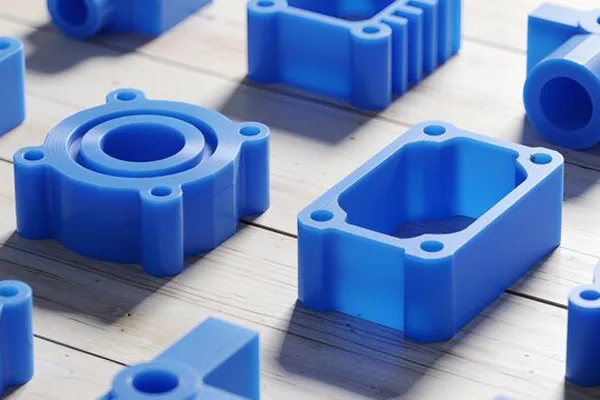
Plastic parts
Key Components of Temperature Management in Injection Molding
Melt Temperature Control
Achieved through precise regulation of the barrel heater zones. Ensures the polymer reaches and maintains its optimal melting point. Modern systems utilize multiple zones with independent temperature controls for fine-tuning.
Tool/ Mold Temperature Control
Managed via cooling channels, heaters, or a combination.
Maintains uniform mold temperature to promote consistent flow and cooling.
Injection Temperature Profile
Carefully programmed to balance flowability and minimize defects.
Typically involves ramping the temperature during injection for optimal fill.
Cooling System Efficiency
Incorporates properly designed channels, often with temperature sensors.
Ensures rapid and uniform cooling to reduce cycle time and prevent warping.
Techniques and Technologies for Effective Temperature Control
Precisely Calibrated Thermocouples and Sensors: Monitor real-time temperatures for accurate adjustments.
- Advanced Temperature Controllers: Digital systems that automate heating, cooling, and feedback loops.
- Conformal Cooling Channels: 3D-printed or machined channels that conform to mold surfaces, providing uniform cooling.
- Heated Mold Inserts and Jackets: Maintain consistent mold temperatures, especially for complex parts.
- Material-Specific Temperature Profiles: Customized profiles based on material properties for optimal results.
Among these, conformal cooling represents a significant leap forward in temperature management. Traditional cooling channels are drilled in straight lines, meaning they often cannot get close to complex or curved mold surfaces. This creates “hot spots” that cool slowly. With additive manufacturing, designers can create cooling channels that follow the exact contours of the part. This technique can reduce cooling times by 30 to 50 per cent and dramatically improve parton homogeneity by eliminating temperature gradients across the die face. It is a prime example of how advanced temperature control technology directly translates into competitive advantage through faster cycles and higher quality.
Moreover, the rise of Industry 4.0 has transformed temperature control from a passive activity to an active, predictive one. Modern temperature controllers are now networked devices that communicate with a central manufacturing execution system (MES). They can record temperature data for each cycle, creating a digital fingerprint for each section. If a temperature sensor detects a drift outside the established process window, the system can automatically reject the affected part or even halt production before a significant scrap run occurs. This closed-loop control ensures that temperature management is not just about hitting a setpoint, but about maintaining control of the statistical process over millions of cycles.
Conclusion
Temperature management is undeniably one of the most critical aspects of plastic injection molding. Its importance is highlighted by its effects on material flow, surface quality, dimensional accuracy, cycle time, and material completeness. Achieving optimal temperature control requires a combination of precise equipment, thoughtful mold design, and vigilant process monitoring.
By prioritizing temperature regulation, manufacturers can efficiently produce high-quality, consistent parts, reduce waste, and extend the lifespan of dies and equipment. As technology advances, innovations in temperature control systems continue to enhance the capabilities and reliability of the injection molding process, ensuring that this fundamental aspect remains central to manufacturing excellence.