
Injection molding is one of the most versatile and widely used manufacturing processes for the production of high volume plastic parts. To meet the increasing demand for materials with enhanced properties, engineers and manufacturers often turn to polymer blends-combinations of two or more polymers that offer tailored properties that cannot be achieved with a single polymer alone. This comprehensive guide aims to provide an in-depth understanding of polymer blends, their advantages, types, processing considerations, and best practices for successful implementation in injection molding.
What Are Polymer Blends?
Polymer blends are physical mixtures of two or more different polymers that are combined to create a material with specific performance attributes. Unlike copolymers, which are chemically bonded, blends are typically immiscible or partially miscible, resulting in a heterogeneous structure. The goal of blending is to synergistically combine desirable properties such as strength, flexibility, heat resistance, chemical resistance, and processability.
Advantages of Using Polymer Blends in Injection Molding
Enhanced Mechanical Properties: Blends can improve tensile strength, impact resistance, and toughness.
Tailored Thermal Characteristics: Adjusting blend ratios can optimize heat deflection temperatures and melting points.
Improved Chemical Resistance: Certain blends provide better resistance against solvents, oils, and other chemicals.
Cost Efficiency: Blending cheaper polymers with high-performance materials can reduce overall material costs.
Design Flexibility: Blends enable the creation of parts with specific aesthetic and functional attributes.
Common Types of Polymer Blends in Injection Molding
- Compatible Blends: Polymers that are chemically or physically compatible, resulting in a homogeneous mixture with uniform properties.
- Incompatible (Immiscible) Blends: Polymers that do not naturally mix but can be combined with compatibilizers to improve interfacial adhesion.
- Compatibilized Blends: Incorporate compatibilizers—block or graft copolymers—that enhance interfacial adhesion and mechanical properties.
Processing Considerations for Polymer Blends
Material Selection: Choose compatible polymers based on desired properties and processing temperatures.
Processing Temperatures: Adjust melt temperatures to accommodate different polymer flow characteristics and avoid degradation.
Mold Design: Optimize mold design to facilitate uniform filling and cooling, especially for heterogeneous blends.
Processing Equipment: Use machines capable of precise temperature and pressure control to ensure consistent blending.
Additives and Compatibilizers: Incorporate appropriate additives to improve blend stability and performance.
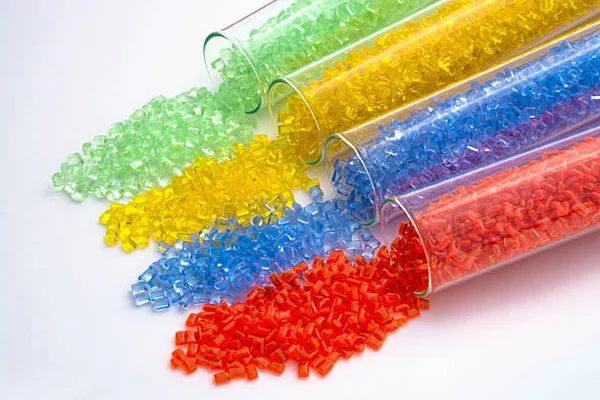
Plastic raw materials
Challenges in Using Polymer Blends
Phase Separation: Immiscible blends may lead to phase separation, affecting mechanical properties.
Processing Complexity: Different polymers may require distinct processing conditions, complicating the process.
Material Compatibility: Not all polymers are compatible; improper blending can result in inferior parts.
Recycling and Sustainability: Blends can be more challenging to recycle due to phase separation and mixed polymer properties.
Best Practices for Successful Polymer Blending in Injection Molding
- Thorough Material Testing: Conduct rheological, mechanical, and thermal testing to understand blend behavior.
- Use of Compatibilizers: Employ suitable compatibilizers to improve blend homogeneity and performance.
- Process Optimization: Fine-tune injection parameters such as temperature, pressure, and cooling rate.
- Quality Control: Implement rigorous inspection protocols to detect phase separation or defects.
- Design for Compatibility: Incorporate design features that accommodate the properties of blends, such as adjusting wall thickness or gate locations.
Future Trends in Polymer Blends for Injection Molding
Advancements in nanotechnology and material science continue to expand the possibilities for polymer blends. The development of biodegradable blends, high-performance composites, and smart materials with integrated sensors are shaping the future of injection-molded parts. Additionally, sustainability efforts are leading to more recyclable and eco-friendly blend formulations.
Conclusion
Polymer blends offer a powerful tool for customizing material properties in injection molding, enabling the production of parts that meet specific performance, aesthetic, and cost requirements. Successful utilization requires careful selection of materials, understanding of their interactions, and meticulous process control. By following best practices and staying abreast of emerging trends, manufacturers can leverage polymer blends to innovate and optimize their injection molding applications, gaining a competitive edge in the marketplace.