
Metal Injection Molding (MIM) has revolutionized the manufacturing of medical components by enabling the production of highly intricate, precise, and durable metal parts at a competitive cost. As the medical industry pushes toward miniaturization and complex device designs, MIM offers a versatile solution that meets stringent quality and performance standards.
The Metal Injection Molding Process: An Overview
Metal Injection Molding combines powder metallurgy with plastic injection molding techniques. The process begins with mixing fine metal powders with a binder to create a feedstock. This feedstock is then injected into a mold under high pressure, forming the desired shape. After molding, the part undergoes debinding to remove the binder, followed by sintering at high temperatures, which fuses the metal particles into a dense, strong component. This process allows for the production of complex geometries with tight tolerances, often comparable to machining, but at a lower cost for high-volume production.
Core Advantages of Metal Injection Molding for Medical Applications
MIM offers several key benefits that make it ideal for medical devices:
- High Precision and Complex Geometries: Enables intricate designs that improve functionality and patient outcomes.
- Material Versatility: Supports biocompatible metals such as stainless steel, titanium, and cobalt-chromium alloys.
- Cost-Effectiveness: Especially advantageous for medium to high-volume production runs.
- Consistent Quality: Ensures uniformity necessary for regulatory compliance.
- Design Flexibility: Facilitates innovative device features that are difficult to achieve with traditional manufacturing methods.
Materials in Medical Metal Injection Molding (MIM)
Choosing the right materials is crucial for the success of Medical Metal Injection Molding (MIM), as it directly impacts the biocompatibility, durability, and performance of the final components. The most commonly used materials in medical MIM applications include:
Stainless Steel
Types: 17-4 PH, 316L, 420, 440C
Properties: Excellent corrosion resistance, strength, and sterilization compatibility.
Titanium and Titanium Alloys
Properties: Biocompatible, lightweight, corrosion-resistant, and high strength-to-weight ratio.
Cobalt-Chromium Alloys
Properties: High wear resistance, strength, and corrosion resistance.
Tantalum
Properties: Excellent biocompatibility and corrosion resistance.
Bioresorbable Metals (Emerging)
Materials: Magnesium alloys
Properties: Biodegradable and resorbable in the body.
Metal Injection Molding in Surgical Instruments
Minimally Invasive Surgery (MIS)
Driver: Need for tiny, complex parts for procedures through small incisions.
Components: Drive chains, end effectors, forceps jaws, articulation joints (<5 mm).
Key Advantage: Creates internal cable channels and undercuts impossible with CNC machining.
Endoscopic & Biopsy Devices
Components: Biopsy forceps jaws, linkages, cannulae.
Requirement: Sharp, strong, and small enough (2.0–3.8 mm diameter) for endoscope channels. MIM delivers precision and strength.
Single-Use Instruments
Trend: Shift from reusable to disposable due to contamination concerns and reprocessing costs.
MIM Benefit: Net-shape parts with >95% material utilization. Once tooling is amortized, cost per piece is much lower than machining. Used for forceps, scalpels, clamps, needle holders.
Surgical Robotics
Components: End effectors with internal cable routing and sensing features.
Benefit: Monolithic assemblies reduce assembly costs and eliminate welded joints, improving reliability.
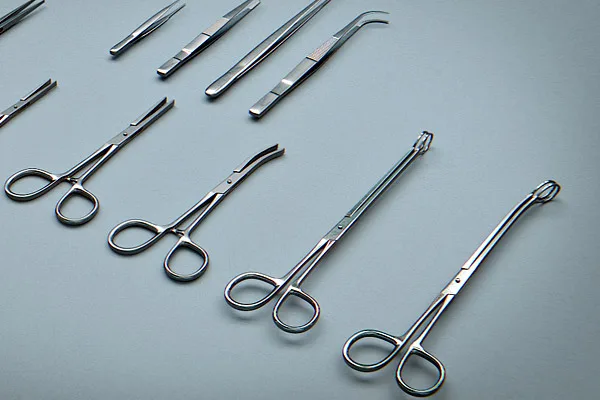
Forceps
Metal Injection Molding in Implantable Devices
Orthopedic Implants
Components: Bone screws, plates, anchors, interference screws.
Features: Porous structures for osseointegration, locking threads, self-tapping flutes.
Economic Case: Near-net shape saves material and labor vs. machining from bar stock.
Dental Implants & Orthodontics
Implants: Titanium alloy artificial tooth roots with precise threads and textures.
Orthodontics: Brackets with complex slots and tie-wings. MIM enables mass customization.
Cardiovascular Implants (Stents)
Innovation: NiTi (nitinol) unibody stents via MIM (alternative to laser cutting).
Performance: Tensile strength 812 MPa, elongation 5.7%, recovers fully at 5% strain. Withstands >390 million fatigue cycles.
Benefit: No welds or knots, eliminating failure points. Enables porous/gradient structures for drug elution.
Emerging Bioabsorbable Implants
Concept: Temporary implants (scaffolds, plates) that degrade safely, avoiding removal surgery.
Materials: Iron-manganese (Fe-Mn) based alloys, Fe-Mn-Si-Cu, Fe-Mn-Si-Pt/Au.
MIM Advantage: Precise control over microstructure, porosity, and degradation kinetics.
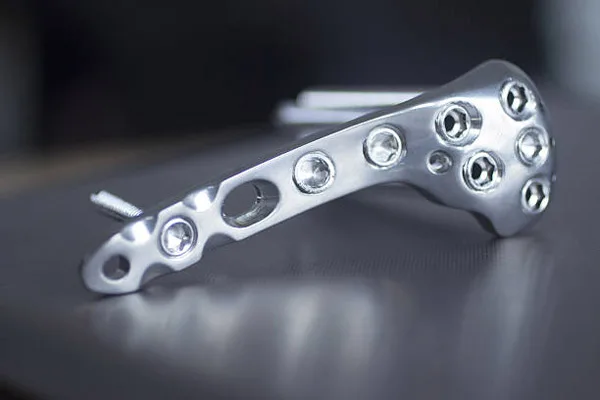
Bone screws
Micro-MIM: Precision at the Sub-Millimeter Scale
Advancements in Micro-MIM have pushed the boundaries of miniature manufacturing, enabling the production of components at sub-millimeter dimensions. This technology is crucial for developing tiny, high-precision parts used in implantable devices, micro-surgical tools, and sophisticated diagnostic systems. Micro-MIM maintains tight tolerances and excellent surface finishes, opening new possibilities for innovation in minimally invasive procedures and implant design.
Future Trends and Market Outlook
The global medical MIM market is expected to grow steadily, driven by increasing demand for miniaturized, high-performance medical devices. Innovations in materials, such as bioresorbable metals and advanced alloys, will expand MIM’s application scope. Additionally, integration with additive manufacturing and other advanced technologies will further enhance design flexibility and customization capabilities. As regulatory standards become more rigorous, MIM’s ability to produce consistent, high-quality components will position it as a preferred manufacturing method in the medical sector.
Conclusion
Metal Injection Molding is transforming the landscape of medical device manufacturing by providing a reliable, precise, and cost-effective way to produce complex metal components. From surgical instruments to implantable devices and diagnostic tools, MIM’s versatility and technological advancements continue to drive innovation in healthcare. As the industry evolves, MIM’s role in delivering safer, more effective, and patient-specific medical solutions is poised to expand further, shaping the future of medical technology.