
In the dynamic landscape of construction sites, factory floors, cycle paths and sports arenas, the safety helmet stands as a silent guardian. This ubiquitous piece of personal protective equipment (PPE) is a masterpiece of modern engineering, a complex blend of material science, biomechanics, and precision manufacturing. At the heart of its production lies a transformative process: plastic injection molding. It is this technology that has enabled the evolution of the helmet from a simple protective shell into a high-performance, customizable, life-saving device available to millions of people.
The Significance of Safety Helmets in Industry
Safety helmets serve as the first line of defense against falling objects, electrical hazards, and impacts. Their effectiveness hinges on materials, design, and manufacturing processes that maximize protection without compromising comfort. As workplaces evolve, so does the demand for helmets that are lightweight, durable, and ergonomically designed. Technological advancements have made it possible to meet these criteria through sophisticated manufacturing techniques, with plastic injection molding at the forefront.
Engineering Safety Helmets Through Injection Molding
The design and engineering of safety helmets via injection molding requires meticulous attention to detail to ensure optimal performance and comfort. Several factors are considered:
Unmatched Complexity & Integration
The mold can form a single, seamless shell with intricate geometries—complex curves for aerodynamics, integrated brims, reinforced ribs for torsional rigidity, and precise slots for accessory clips (for face shields, hearing protection, or headlamps). This removes the weakness of the joining part.
Superior Material Properties
The high pressure forces the molten plastic into every detail of the mold, resulting in dense, consistent sections with excellent surface finish and uniform wall thickness. This consistency is crucial for predictive influence performance.
High-Volume Efficiency
Once the mold is created and installed, the cycle time to produce a single shell can be as low as 30-60 seconds. These economies of scale make high-quality protection affordable and widely available.
Material Versatility
Engineers can select from a vast polymer portfolio. A tough, glossy polycarbonate shell might be chosen for a construction helmet, while a lightweight, aerodynamic ABS blend might be chosen for a cycling helmet.
The Anatomy of Protection: A Multi-Component, Multi-Material System
A modern safety helmet is rarely a single injection-molded part. It is a system in which injection molding is used to fabricate several of its critical components:
1. The Outer Shell: The first line of defense. Its job is not to absorb the impact directly, but to distribute the load over a wider area and provide penetration resistance. It is engineered to be hard and stiff, often with a textured or glossy finish molded right in.
2. The Inner Liner – The Energy Absorber: This is the helmet’s core lifesaving component. For decades, this was exclusively Expanded Polystyrene (EPS) foam, created in a separate molding process. However, modern advanced helmets now increasingly use in-mold technology. Here, the EPS foam liner is pre-formed and placed inside the shell mold. When the molten plastic for the shell is injected, it fuses directly to the foam, creating a monolithic, inseparable bond. This eliminates gaps, improves durability, and enhances overall structural integrity.
3. The Suspension System: The harness that keeps the helmet positioned on the head. Its nylon or polyethylene straps, adjustment dials (like a rotary ratchet system), and anchor points are almost exclusively produced via injection molding. This allows for the precise, durable and low-friction components needed for a secure and comfortable fit.
4. Accessories & Details: The visor, ventilation plug, ear protection attachment, and reflective badge are all produced efficiently and economically through injection molding, ensuring color match and functional compatibility with the main case.
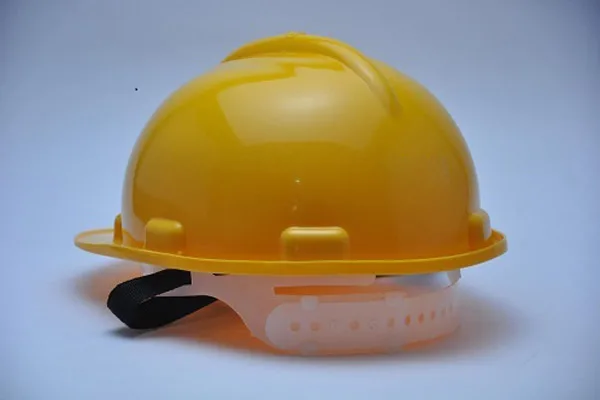
Plastic safety helmet
Engineering for Life: Advanced Techniques and Innovations
The quest for better protection, comfort and functionality has pushed injection molding technology to new frontiers.
Multi-Material / Overmolding
This allows different plastics to be combined in a single molding cycle. A soft, flexible thermoplastic elastomer (TPE) can be overmolded onto a hard polycarbonate shell to create comfortable, grippy brow pads or seals that are permanently bonded, eliminating glue and improving hygiene.
In-Mold Decoration (IMD)
Labels, graphics, and even complex high-resolution designs can be placed inside the mold before injection. The molten plastic flows over it, encapsulating the trim beneath a durable, wear-resistant layer. This is why helmet logos never peel off.
Gas-Assisted Injection Molding
Used for larger components, this technique injects nitrogen gas into the molten plastic. It creates hollow channels within thick sections, reducing weight and material use while minimizing sink marks and improving rigidity – key for large-format industrial helmets.
Sustainable Materials
The industry is increasingly using recycled polymers or bio-based plastics for injection molding. Post-consumer recycled ABS or polycarbonate can be expertly molded into new shells, closing the material loop without compromising safety standards.
The Rigorous Path to Certification
Each injection-molded helmet is the product of relentless testing. Before mass production, prototypes undergo brutal impact tests (strikes from specified heights onto flat and anvil surfaces), penetration tests, chin strap tests, and environmental tests (exposure to UV, water, and extreme temperatures). The injection molding process must produce parts so consistent that any helmet pulled from the production line will perform identically to the certified prototype. This repeatability is perhaps the greatest contribution of plastic injection molding to safety.
The Future, Molded Today
Looking ahead, injection molding will continue to be a cornerstone of helmet manufacturing, even as the helmets themselves get smarter. The process is perfectly suited to integrate the next generation of features: molded-in cavities and channels for built-in sensors (for impact detection or fatigue monitoring), cable management for communication systems, and stable platforms for augmented reality displays.
From hard hats to shield construction workers from falling tools to ventilating helmets to protect cyclists in a crash, modern safety helmets are a testament to sophisticated engineering. Plastic injection molding is the enabling technology that brings this engineering to life, transforming polymer granules into robust, reliable, and vital forms of protection.