
Metal stamping is a highly versatile and efficient manufacturing process used to produce a wide variety of metal parts and components. From automotive parts to household appliances, metal stamping plays a crucial role in modern industry. This comprehensive guide explores the fundamentals of metal stamping, its advantages, applications, and the key factors to consider when choosing this process for your production needs.
What is Metal Stamping?
Metal stamping, also known as pressing or die cutting, involves shaping or cutting metal sheets or coils into specific forms using a press and specialized dies. The process encompasses a variety of techniques such as punching, blanking, embossing, bending, and coining, allowing manufacturers to produce complex shapes with high precision.
The basic process includes feeding raw metal material into a stamping press, where it is shaped, cut, or formed by dies that exert significant force. The result is a finished part that can be used directly or further assembled into larger products.
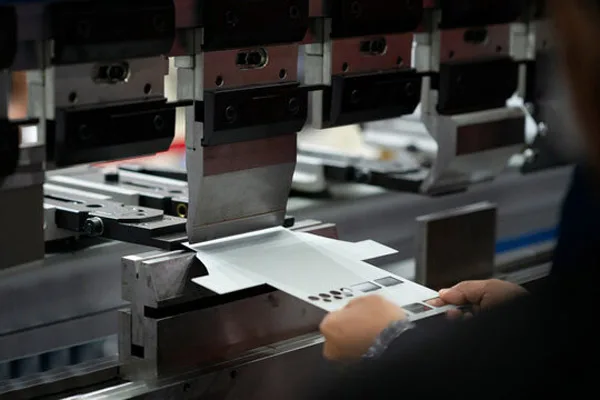
Metal stamping
Types of Metal Stamping Processes
Metal stamping encompasses several specific methods, each suited for different types of parts and production volumes:
Deep Drawing: Used to produce hollow, cup-shaped, or cylindrical parts like cans and cookware.
Progressive Die Stamping: Involves multiple stamping operations performed sequentially in a single press to produce complex parts efficiently.
Transfer Die Stamping: Suitable for high-volume production of complex parts, where a part is transferred between stations.
Coining: Applies high pressure to create detailed surface textures or precise features.
Embossing and Flanging: Used for creating decorative patterns or joining edges.
Overview of Common Stamping Operations
1. Blanking – cuts the entire outer contour of the part from the sheet, producing a flat blank that will be further formed.
2. Piercing– creates holes, slots, or cutouts in the material. The removed portion is scrap.
3. Bending – deforms the material along a straight axis to create angles, channels, or U-shapes, using v‑dies, wiping dies, or rotary benders.
4. Drawing – forms flat blanks into concave or convex shapes, such as cups and shells, by pulling the material into a die cavity.
5. Lancing – makes a partial cut and bends the material to create tabs or louvers without separating the scrap.
6. Shaving – removes a thin layer from sheared edges to improve dimensional accuracy and surface finish.
7. Ironing – thins and smooths the walls of drawn parts, commonly used in beverage can production.
Material Selection Guide for Stamping
Steel: Exhibits high strength and durability, making it suitable for a wide range of applications. Commonly used in automotive and structural components.
Aluminum: Known for its lightweight properties and ease of forming, it is ideal for aerospace and packaging applications.
Copper and Alloys: Possess excellent thermal and electrical conductivity, suitable for electrical and electronic components.
Stainless Steel: Offers superior corrosion resistance and aesthetic appeal, commonly utilized in kitchenware and medical devices.
Advantages of Metal Stamping
Choosing metal stamping offers numerous benefits that make it an attractive option for manufacturers:
- High Production Speed: Once the dies are designed, the process can produce thousands to millions of parts rapidly, making it ideal for high-volume manufacturing.
- Cost-Effective for Large Quantities: The initial tooling investment can be substantial, but the per-unit cost decreases significantly with volume, resulting in excellent economies of scale.
- Precision and Consistency: Stamping produces parts with tight tolerances and repeatability, ensuring uniform quality across large batches.
- Design Flexibility: Modern stamping techniques accommodate complex geometries, intricate details, and fine features.
- Material Compatibility: Suitable for a wide range of metals, including steel, stainless steel, aluminum, copper, and alloys.
- Minimal Waste: The process is efficient in material utilization, often generating minimal scrap.
Design for Manufacturability (DFM) Best Practices for Stamping
To maximize tool life, reduce scrap, and ensure consistent quality, parts should be designed with stamping in mind. Key DFM guidelines include:
- Minimum bend radius – generally equal to or greater than the material thickness. For high‑strength steels, use 1.5× thickness or more to prevent cracking.
- Hole diameter – should be at least 1.2× the material thickness to avoid punch breakage.
- Distance from hole to edge – maintain at least 1.5× thickness to prevent edge tearing.
- Distance from bend to hole – keep holes at least 2.5× thickness away from the bend line to avoid distortion.
- Tolerances – assign tighter tolerances only to critical features; looser tolerances reduce die cost and maintenance.
- Symmetrical design – where possible, symmetrical parts simplify feeding and orientation in progressive dies.
- Avoid sharp internal corners – use radii of at least 0.5× thickness to reduce stress concentration and extend die life.
Limitations and Considerations
While metal stamping is advantageous, it is not suitable for every application. Some limitations include the high initial tooling costs, as designing and manufacturing dies can be expensive and time‑consuming, which makes the process less practical for low‑volume or prototype production. In addition, stamping is most effective with thin to moderate sheet metal; very thick materials may require alternative methods. Furthermore, certain complex or very deep features may be challenging to produce with stamping alone. Finally, the lead time for developing custom dies can take weeks or months, which may impact project timelines.
Quality Control and Inspection in Stamping
Achieving zero‑defect production in stamping demands robust quality assurance, and common inspection methods include several key approaches. In‑process monitoring utilizes sensors to detect material feeding, employs die protection systems to check for slug pulling or misfeeds, and uses tonnage monitors to track press force for identifying tool wear. First‑article inspection (FAI) provides comprehensive dimensional verification of the first parts off the tool, employing coordinate measuring machines (CMMs), optical comparators, or laser scanners. Statistical process control (SPC) involves real‑time data collection on key dimensions, which allows early detection of dimensional drift and enables proactive die maintenance. Visual inspection employs automated vision systems that can check surface defects, burrs, and cosmetic appearance at full production speed. Finally, for critical parts, destructive and non‑destructive testing—such as tensile tests, hardness checks, or X‑ray inspection—may be employed to ensure material integrity.
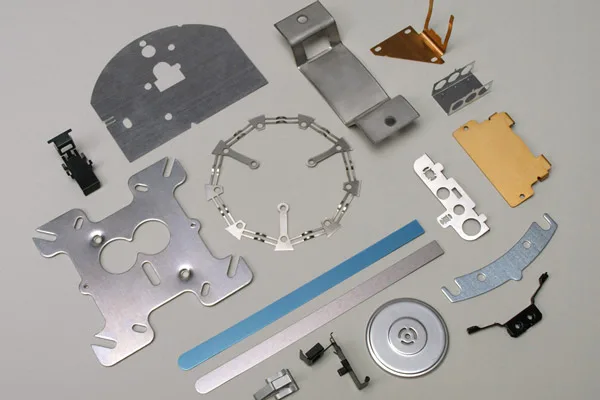
Metal stamping parts
Applications of Metal Stamping
Metal stamping is employed across numerous industries, including
Automotive: Body panels, brackets, and engine components.
Aerospace: Structural parts, brackets, and connectors.
Electronics: Connectors, enclosures, and shielding components.
Consumer Goods: Household appliances, cookware, and hardware.
Medical Devices: Surgical instruments and device components.
Emerging Trends and Industry 4.0 in Stamping
Modern stamping is increasingly integrated with digital technologies. For example, servo‑driven presses offer programmable ram motion, which allows optimized speed and force profiles for each forming operation, thereby reducing stress on the tooling and extending die life. Automated coil handling and loading systems, including robotic decoilers and levelers, reduce manual intervention, improve workplace safety, and ensure a consistent feed rate. Smart sensors and IoT devices enable real‑time data acquisition on press temperature, vibration, and lubrication, which supports predictive maintenance and significantly reduces unplanned downtime. Digital twin simulation allows engineers to simulate the entire forming process in software before building the physical die, so they can predict springback, thinning, and wrinkling and make early corrections. Additionally, additive manufacturing for tooling—such as 3D‑printed inserts with conformal cooling channels—can improve heat dissipation in dies, speeding up production and reducing thermal distortion.
Sustainability and Environmental Considerations
As manufacturers face tighter environmental regulations and consumer expectations for green products, stamping offers several eco‑advantages. First, well‑designed strip layouts can achieve over 85% material yield, which significantly reduces scrap and raw material consumption. In addition, most stamping materials—such as steel, aluminum, and copper—are infinitely recyclable, and the scrap generated is typically returned to the supply chain as clean, segregated material. Furthermore, cold‑forming stamping consumes far less energy than hot processes like casting or forging, thereby reducing the carbon footprint per part. Progressive dies also often produce finished parts in a single pass, which eliminates energy‑intensive secondary machining steps. Finally, many stamping operations now use biodegradable or synthetic coolants and washable oils, minimizing environmental impact while maintaining performance.
Conclusion
Metal stamping remains a cornerstone of manufacturing for high-volume, precise, and cost-effective production of metal parts. Its ability to produce complex geometries quickly and consistently makes it an ideal choice for industries ranging from automotive to electronics. By understanding the process, advantages, and limitations, manufacturers can make informed decisions to leverage metal stamping for their production needs, ensuring quality, efficiency, and cost savings.