
The hearing aid industry has undergone a remarkable transformation over the past few decades, driven by technological advances that enhance device performance, personalization and accessibility. Among these innovations, Stereolithography (SLA) manufacturing has emerged as a game-changer, revolutionizing how hearing aids are designed, produced, and customized. This article explores the profound impact of SLA technology on the hearing aid industry, highlighting its benefits, technical processes, and future potential.
The Evolution of Hearing Aid Manufacturing
Traditionally, hearing aids were manufactured using conventional methods such as injection molding and subtractive manufacturing processes. While these techniques are effective, they often involve lengthy production times, limited customization options, and higher costs. The need for more precise, personalized and efficient manufacturing solutions has led to the adoption of additive manufacturing technologies, with SLA taking center stage.
What is SLA Manufacturing?
Stereolithography (SLA) is an additive manufacturing process that utilizes a laser or ultraviolet light to cure liquid resin into solid, three-dimensional objects layer by layer. Known for its high resolution and accuracy, SLA enables the production of intricate and highly detailed components with a smooth surface finish. In the context of hearing aids, SLA facilitates the creation of custom shells, ear molds, and internal components that fit perfectly and function optimally.
Technical Refinements for Medical Applications
The adaptation of SLA for hearing aids requires significant advances in both hardware and materials. Manufacturers have developed specialized biocompatible resins that are durable, hypoallergenic and stable in the moist environment of the ear. Simultaneously, printer accuracy has improved, with layers now as fine as 25 microns – enabling the capture of the subtlest anatomical details. This technological maturity allows SLA to meet the rigorous standards of medical device manufacturing, including reproducibility and material safety.
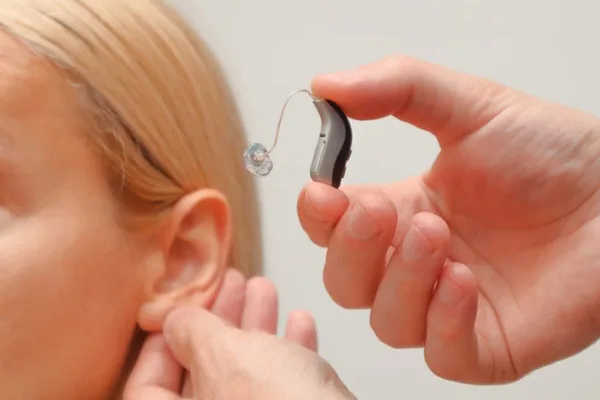
SLA hearing aids
Transformative Benefits of SLA in Hearing Aid Production
1. Unmatched Precision and Customization
One of SLA’s most notable strengths is its ability to produce highly accurate and customized components. Hearing aids must fit the unique contours of each individual ear canal to ensure comfort and optimal sound quality. SLA’s fine resolution allows manufacturers to craft intricate ear molds and shells tailored to each user’s anatomy, resulting in a more comfortable and effective device.
Micro-Feature Integration
Beyond basic fitting, SLA enables the integration of microscopic features directly into the hearing aid housing. This includes sub-millimeter vents to reduce occlusion effects, precise channels for microphone and receiver placement, and even internal acoustic resonators to tune the frequency response. Such features, which could not be consistently achieved with manual methods, are now printed with exact reproducibility.
2. Rapid Prototyping and Production
SLA significantly reduces the time from design to production. Traditional manufacturing methods can take weeks to produce a single prototype or final product. SLA enables rapid prototyping, allowing designers and engineers to quickly test and refine hearing aid designs. This accelerated process leads to faster innovation cycles and faster delivery to consumers.
3. Reduced Costs and Material Waste
Additive manufacturing, including SLA, is more material-efficient than subtractive methods. It uses resin only where it is needed, minimizing waste and reducing production costs. For hearing aid manufacturers, this means lower material costs and the ability to produce complex geometries without the need for expensive molds or tooling.
Enhanced Design Flexibility
SLA’s capabilities allow for complex geometries and innovative designs that were previously challenging or impossible with traditional methods. This flexibility allows designers to incorporate new features, improve acoustic performance, and develop more ergonomic and discreet hearing aid models.
4. Enabling Discreet and Ergonomic Designs
The rise of completely-in-canal (CIC) and invisible-in-canal (IIC) hearing aids is a direct result of SLA’s precision. These devices require a perfect fit deep in the ear canal for both retention and acoustic performance—a feat achievable only through high-resolution additive manufacturing. Designers can also create shells with varying wall thicknesses, combining rigid sections for electronics with flexible areas for comfort.
5. Improved Patient Experience
Custom-fitted hearing aids produced via SLA technology result in better comfort, reduced irritation, and improved sound quality. Patients benefit from devices that are not only personalized but also more aesthetically pleasing due to the potential for intricate, sleek designs.
Technological Process of SLA in Hearing Aid Manufacturing
The SLA process begins with the creation of a detailed digital model of the hearing aid components, often derived from scans of the patient’s ears. The design is then sliced into thin layers, and the SLA machine uses a UV laser to selectively cure the resin layer by layer. Once the printing is complete, the parts undergo post-processing, including cleaning and curing, to achieve a final polished, durable finish.
This process allows for rapid iteration and customization, making it ideal for small-batch production and personalized solutions.
Future Outlook and Innovations
Integration of SLA technology with other advancements such as digital scanning, AI-driven customization, and biocompatible materials promises a future where hearing aids are more personalized, affordable, and accessible. Researchers are exploring new resin formulations that mimic the flexibility and durability of biological tissues, potentially leading to more comfortable and long-lasting devices.
In addition, as SLA printers become more affordable and scalable, smaller clinics and audiologists may be able to produce customized hearing aids on-site, reducing patient wait times and costs.
Conclusion
SLA manufacturing has profoundly transformed the hearing aid industry by enabling unprecedented levels of precision, customization and efficiency. Its adoption has led to better fitting devices, faster production cycles, and innovative designs that enhance the user experience. As technology continues to advance, SLA is poised to play an even more significant role in making hearing aids more accessible, effective and comfortable for millions of users worldwide.
The ongoing evolution of SLA and related additive manufacturing technologies signals a future where hearing health solutions are tailored to individual needs as never before – ushering in a new era of personalized healthcare. The transformation stands as a testament to how digital fabrication can humanize technology, transforming a generic medical device into a seamless, personal accessory that restores not just hearing but connectivity and quality of life.