
Vacuum Forming vs. Injection Molding: How to Choose the Right Process for Your Parts
When it comes to manufacturing plastic parts, choosing the right process is crucial to ensure quality, cost-efficiency, and meeting project deadlines. Two popular methods are Vacuum Forming and Injection Molding. While both serve the purpose of producing plastic components, they are suited for different applications, production volumes, and quality requirements. This article will compare Vacuum Forming and Injection Molding across various factors to help you make an informed decision for your project.
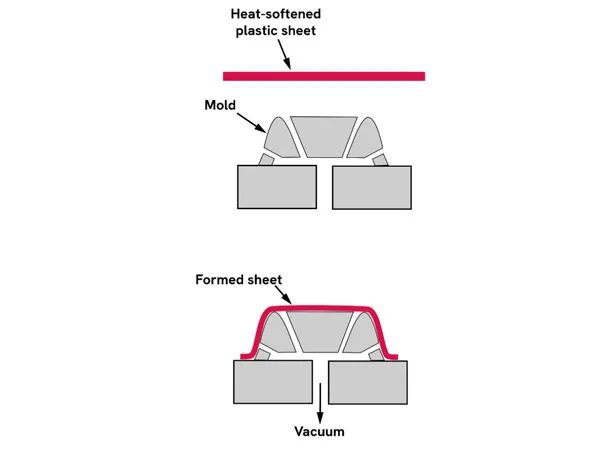
Vacuum forming process
What is Vacuum Forming?
Vacuum Forming is a manufacturing process that involves heating a thermoplastic sheet until it becomes pliable. The heated sheet is then stretched over a mold, and a vacuum is applied to draw the plastic tightly against the mold surface. Once cooled and hardened, the formed plastic is trimmed to produce the final part. This method is commonly used for creating packaging, trays, automotive components, and display items.
Advantages of Vacuum Forming
- Cost-Effective for Small to Medium Batches: Low tooling costs compared to injection molding, making it ideal for prototypes and short production runs.
- Fast Production Turnaround: Rapid setup and forming process allow for quick fabrication of parts.
- Flexible Design Options: Easy to modify molds, enabling quick design iterations.
- Wide Range of Materials: Compatible with various thermoplastics like ABS, PETG, polycarbonate, and PVC.
- Good Surface Finish: Produces parts with smooth surfaces suitable for aesthetic applications.
Limitations of Vacuum Forming
- Limited to Simple Geometries: Not suitable for highly detailed or intricate designs; deep undercuts and complex features are challenging.
- Lower Precision: Tolerance and dimensional accuracy are generally less precise than injection molding.
- Material Thickness Constraints: Limited to relatively thin materials; thicker sheets may be difficult to form uniformly.
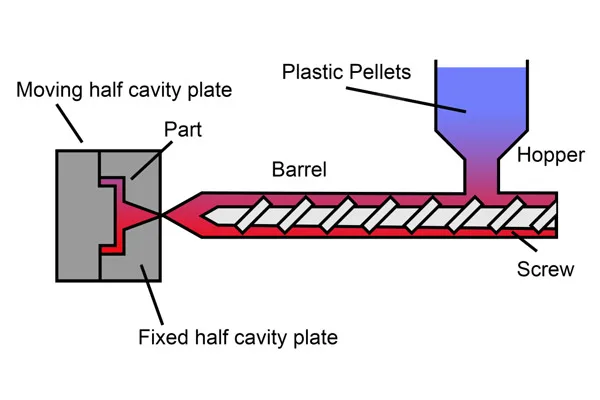
Injection molding process
What is Injection Molding?
Injection Molding involves creating a steel or aluminum mold into which molten plastic is injected under high pressure. This process is widely used for mass production of high-quality, durable plastic parts with consistent dimensions.
Advantages of Injection Molding
- High-volume production: Capable of producing thousands or millions of parts efficiently.
- Excellent consistency: Parts are uniform with tight tolerances.
- Material variety: Compatible with a broad range of thermoplastics and thermosets.
- Durability: Molds last for extensive production runs.
- Cost per unit decreases with volume: Economical for large batches.
Limitations of Injection Molding
- Initial tooling costs: High upfront investment for mold fabrication.
- Longer lead times: Mold design and manufacturing can take weeks or months.
- Less suitable for small runs or prototypes: Costly for low-volume production.
Comparing Key Factors
|
Factor |
Vacuum Forming |
Injection Molding |
| Production Volume | Best for low to medium volumes | Suitable for high-volume production |
| Lead Time | Rapid setup; parts can be produced within days | Longer lead times; mold fabrication can take weeks or months |
| Initial Cost | Low; minimal tooling costs, mainly silicone molds | High; expensive metal molds required |
| Surface Finish & Detail | Excellent surface finish with high detail; good for visual prototypes | Very high quality and precision; suitable for end-use parts requiring tight tolerance |
| Material Options | Wide range of thermoplastics like ABS, PETG, PVC, and specialty materials | Extensive options including engineering plastics like nylon, polycarbonate, and ABS |
| Design Flexibility | High; easy to modify design during prototyping stages | Limited; modifications require new molds, increasing costs |
| Part Durability & Mechanical Properties | Generally less durable; ideal for visual models or prototypes | Highly durable; designed for functional, load-bearing parts |
| Tolerance & Accuracy | Good but slightly less precise; suitable for aesthetic parts | Extremely precise and consistent with tight tolerances |
| Tooling & Maintenance | Silicone molds are inexpensive but wear out quickly; need replacement after limited cycles | Steel or aluminum molds are costly but last for thousands of cycles |
| Cost per Part | Higher at larger volumes; economical for small batches | Cost per part decreases significantly with volume, making it economical for mass production |
| Speed of Production | Very fast for small batches or prototypes | Slow initial setup but very fast for large quantities |
| Environmental Impact | Lower energy consumption; less waste | Higher energy use; more waste generated at large volumes |
Practical Applications and Industry Use Cases
Vacuum Forming Applications
Rapid prototyping for visual and fit tests.
Low to medium production runs of packaging, trays, and panels.
Custom enclosures and displays.
Medical devices and prototypes requiring aesthetic appeal.
Automotive interior parts and lightweight components.
Injection Molding Applications
Mass production of consumer goods (toys, electronics housings).
Automotive parts requiring durability and precision.
Medical devices and end-use components.
Industrial components with tight tolerances.
High-volume packaging and household items.
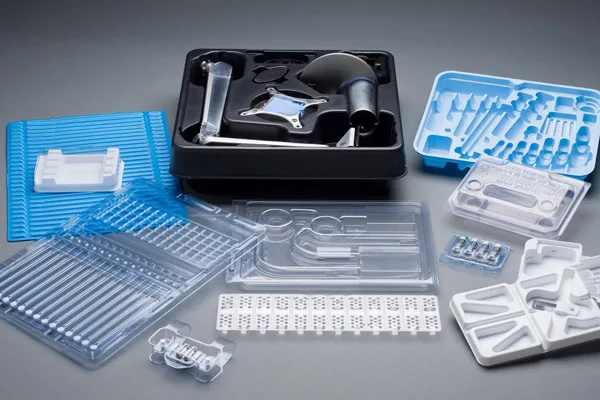
Plastic containers

Plastic electronics housings
Which Manufacturing Process Is Right for Your Project and When?
Opt for Vacuum Forming When:
You need to produce prototypes or small batches quickly.
Your overall production volume is relatively low to medium.
You anticipate making design changes during development stages.
Keeping costs down for limited runs is a priority.
The parts don’t require high strength or load-bearing capabilities.
You want to evaluate form, fit, and function before moving to large-scale production.
Consider Injection Molding When:
You plan to produce large quantities of uniform, durable parts.
Your project requires high accuracy and precise dimensions.
Achieving long-term cost savings is important.
The parts will face mechanical stresses or harsh environmental conditions.
You’re manufacturing complex, multi-material, or load-resistant components.
You have the time and budget for mold fabrication, and long lead times are acceptable.
Final Thoughts
Both Vacuum Forming and Injection Molding have unique advantages suited for different stages of product development. Use vacuum forming for quick, cost-effective prototypes and small batch production. It offers flexibility and fast turnaround, ideal for testing designs and making modifications.
When moving to mass production, injection molding becomes the better choice. It provides high precision, consistent quality, and durability at large scales, reducing long-term costs.
A common strategy is to start with vacuum forming for early prototypes and then switch to injection molding for high-volume manufacturing. Carefully consider your project’s timeline, budget, and complexity to choose the most suitable process. Making the right choice early on ensures efficient production and high-quality results.