
Understanding Composite Materials
Composite materials have a rich history that dates back thousands of years. Early humans used natural composites such as mud mixed with straw to build durable structures, exemplified by ancient adobe homes. The modern concept of composites, however, began to develop in the early 20th century with advancements in materials science. During World War II, the need for lightweight and strong materials for aircraft and military equipment accelerated research into new composite systems. Post-war, the aerospace industry popularized fiber-reinforced composites, leading to their widespread adoption across various industries. Today, composites are integral to sectors ranging from aerospace and automotive to sports and construction, owing to their unique combination of properties.
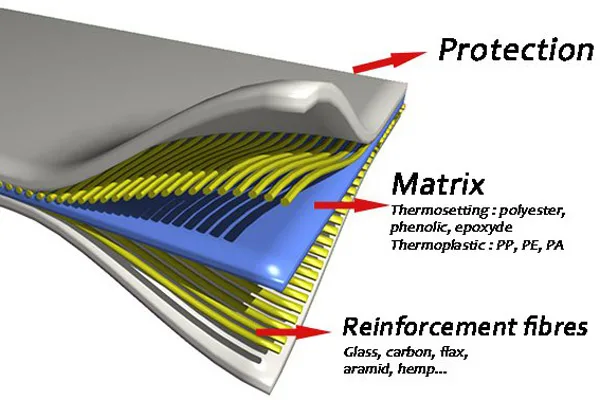
Composite material
What is a Composite Material?
At its most basic level, a composite material is a engineered combination of two or more constituent materials with significantly different physical or chemical properties. When combined, they produce a material with characteristics different from the individual components. The components remain separate and distinct within the finished structure – they do not dissolve or blend completely into one another.
Think of reinforced concrete: steel bars embedded within a concrete matrix. The concrete handles compressive stress, while the steel handles tensile stress. Together, they form a building material far stronger and more useful than either component alone.
Every composite has two key constituents:
The Matrix: The continuous, surrounding phase that holds the reinforcement in place and transfers loads. It protects the reinforcement from environmental damage. Common matrix materials include polymers, metals, or ceramics.
The Reinforcement: The dispersed, discontinuous phase that provides the primary structural properties – strength, stiffness, and toughness. Reinforcements can be fibers, particles, or flakes.
The magic of composites lies in synergy – the combined performance exceeds the sum of their parts.
Major Properties of Composite Materials
Composite materials are characterized by several unique properties:
- High Strength-to-Weight Ratio: Composites can be as strong as metals but significantly lighter, making them ideal for aerospace and automotive applications.
- Corrosion Resistance: Many composites are resistant to corrosion, unlike metals that may rust or deteriorate.
- Tailorable Properties: The properties can be customized by altering the type, orientation, and volume fraction of reinforcements.
- Design Flexibility: Composites can be molded into complex shapes, facilitating innovative design solutions.
- Fatigue and Impact Resistance: Many composites have excellent fatigue life and impact resistance, enhancing durability.
- Thermal and Electrical Insulation: Certain composites provide good insulation properties, useful in electronic and insulation applications.
Types of Composite Materials
Composite materials can be classified based on the type of reinforcement and matrix used:
1. Fiber-Reinforced Composites:
Glass Fiber Reinforced Polymer (GFRP): Common in construction, marine, and automotive industries.
Carbon Fiber Reinforced Polymer (CFRP): Known for high strength and stiffness; used in aerospace, sports equipment.
Aramid Fiber Reinforced Polymer (AFRP): Used in ballistic protection and high-performance applications.
2. Particulate Composites:
Consist of particles dispersed within a matrix, used in applications requiring wear resistance or thermal properties.
3. Structural Composites:
Designed for load-bearing applications, often using fiber reinforcements.
4. Hybrid Composites:
Combine different fibers or reinforcements to optimize properties for specific needs.
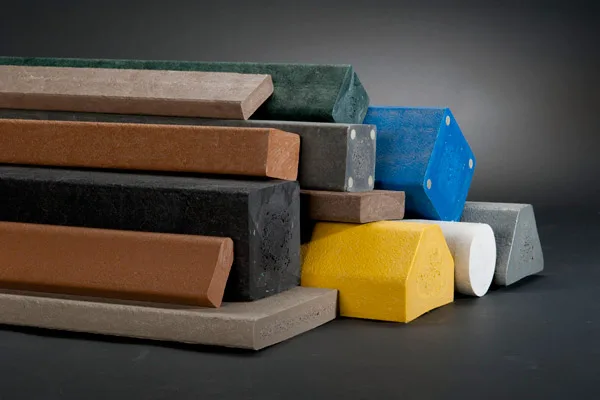
Type of composite building materials
What are the Benefits of Composites?
The advantages of composite materials include:
- Lightweight: Reduced weight leads to fuel savings and increased efficiency in transportation sectors.
- Enhanced Mechanical Properties: Higher strength, stiffness, and toughness compared to traditional materials.
- Design Flexibility: Ability to produce complex shapes and tailor properties for specific applications.
- Corrosion and Environmental Resistance: Longer lifespan and reduced maintenance costs.
- Reduced Material Usage: High strength allows for thinner and lighter components, reducing raw material consumption.
- Energy Efficiency: Lighter components contribute to energy savings in manufacturing, transportation, and operation.
Key Applications Across Industries
Aerospace:
Airplane fuselages, wings, and tail sections utilize CFRP for weight reduction and fuel efficiency.
Automotive:
Lightweight panels, chassis parts, and interior components improve performance and fuel economy.
Construction:
Reinforced concrete, bridge decks, and structural elements benefit from fiber-reinforced composites.
Marine:
Boat hulls, decks, and other components are made with composites for corrosion resistance and strength.
Sports Equipment:
Tennis rackets, golf clubs, bicycles, and helmets leverage high-performance composites.
Electrical and Electronics:
Insulating components, circuit boards, and casings benefit from composite materials’ dielectric properties.
Medical Devices:
Prosthetics, implants, and surgical tools utilize biocompatible composites.
Renewable Energy
- Wind turbine blades: The single largest volume consumer of fiberglass composites. Blades up to 120 meters long must be light yet extremely stiff and fatigue-resistant.
- Tidal turbine blades: Underwater composite blades.
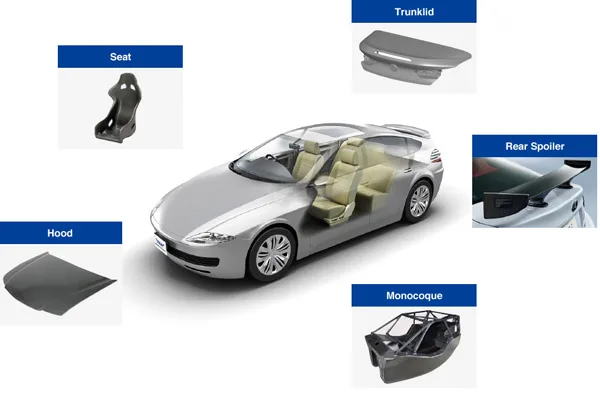
Automotive parts

Wind turbine blades
The Future of Composite Materials
The field is evolving rapidly in three directions:
Thermoplastic Composites:
Instead of thermoset resins, thermoplastics like PEEK, PEKK, or polyamide can be melted and re-melted. This enables faster manufacturing and recyclability – scrap can be reground and remolded. Airbus and Boeing are now evaluating thermoplastic composites for primary structures.
Nanocomposites:
Adding carbon nanotubes (CNTs) or graphene nanoparticles to a polymer matrix can dramatically improve electrical conductivity, thermal conductivity, and mechanical properties. A 1% CNT addition can double fatigue life. Future “multifunctional” composites may act as structural batteries or sensors.
Sustainable, Bio-based composites:
Natural fibers (flax, hemp) combined with bio-derived resins (from plant oils or lignin) to make fully compostable, low-carbon composites. Automotive interior panels, consumer electronics casings, and even surfboards are going green.
Out-of-Autoclave (OOA) manufacturing:
High-quality composites without expensive autoclaves – using vacuum bag only (VBO) or resin infusion processes. Cheaper, larger parts for wind and automotive.
Conclusion
Composite materials have revolutionized the way industries approach design, manufacturing, and sustainability. Their unique ability to combine different materials to produce superior properties has led to innovations in transportation, construction, sports, and beyond. As research progresses, new composites with enhanced properties and environmental benefits will continue to emerge, further expanding their applications. Understanding the types, properties, and benefits of composites is essential for leveraging their potential to create more efficient, durable, and sustainable products for the future