
In recent years, technological advances have continually reshaped the way we experience sound. Among these innovations, 3D printing stands out as a transformative force, offering unprecedented possibilities in speaker design, customization and manufacturing. This revolutionary approach is redefining not only how speakers are made, but also how they are performed and integrated into our daily lives. Let’s explore how 3D printing is revolutionizing the sound industry and what the future holds for this exciting convergence of technology and acoustics.
The Rise of 3D Printing in Audio Technology
3D printing, also known as additive manufacturing, involves creating 3D objects layer by layer based on digital models. Its versatility allows designers and engineers to craft complex geometries that would be difficult, expensive or impossible to produce with traditional manufacturing methods. In the realm of audio technology, this means innovative speaker designs that optimize sound quality, aesthetics and functionality.
The adoption of 3D printing in speaker manufacturing started with prototyping and custom parts, but has rapidly progressed to the production of entire speaker enclosures and components. This shift has opened new avenues for customization, rapid iteration and cost-effective production, especially for small batches or bespoke designs.
Customization and Personalization
One of the most compelling advantages of 3D printing in speaker design is the ability to customize each unit to suit individual preferences. Consumers can choose unique shapes, materials and internal structures to tailor the sound profile and aesthetic appeal. For example, a user might want a speaker that matches their interior decor or personal style, and 3D printing makes this feasible at no significant additional cost.
Also, musicians and audio engineers can design specialized speakers optimized for specific environments or sound characteristics. This level of customization enhances the user experience and provides manufacturers with a competitive edge.
Innovative Design and Acoustic Optimization
Traditional speaker enclosures are typically limited by manufacturing constraints, which can constrain innovative designs. 3D printing frees designers from these limitations, enabling intricate geometries and internal structures that improve acoustic performance.
For instance, complex internal channels and resonant chambers can be precisely engineered to enhance sound clarity, bass response, and overall fidelity. Researchers and designers are exploring lattice structures, porous materials, and biomimetic designs that can affect sound dispersion and absorption, leading to richer and more immersive audio experiences.
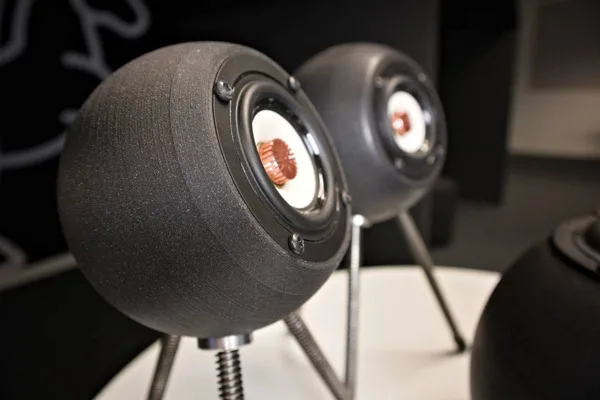
3D printed speakers
Material Innovation and Sustainability
3D printing offers a wide array of materials, from plastics and resins to metals and composites. This diversity allows for the development of lightweight, durable, and environmentally friendly speaker components.
Recyclable and biodegradable materials are increasingly being integrated into the 3D printing process in line with global sustainability goals. In addition, the ability to produce parts on demand reduces waste and transportation emissions, contributing to greener manufacturing practices.
Rapid Prototyping and Cost-Effective Production
The iterative nature of 3D printing accelerates the development cycle. Designers can quickly produce prototypes, test acoustics and make adjustments without the need for expensive molds or tooling. This rapid prototyping capability shortens time-to-market and fosters innovation.
For small-scale production or artisan brands, 3D printing offers a cost-effective solution to produce high-quality speakers without the need for large manufacturing facilities. This democratizes the industry, enabling start-ups and individual inventors to bring their ideas to life.
Challenges and Future Directions
Despite its numerous benefits, integrating 3D printing into mainstream speaker manufacturing faces challenges. Material limitations, print resolution, and scalability are areas that require ongoing research. Ensuring consistent quality and performance across large production runs remains a concern, although advances in printing technology continue to mitigate these issues.
Looking ahead, the future of 3D-printed speakers is promising. As materials evolve and printing techniques become more refined, we can expect even more innovative designs, smarter integration with digital systems, and enhanced acoustic performance. Additionally, the potential for on-demand, localized manufacturing could revolutionize supply chains, making high-quality, customized speakers accessible worldwide.
Conclusion
3D printing is undeniably revolutionizing the sound industry by enabling unprecedented levels of customization, innovative design and sustainable manufacturing. As this technology continues to mature, it is likely to lead to a new era of audio devices that are more personal, efficient and integrated into our digital lives. The future of sound is being crafted layer by layer, and 3D printing is at the forefront of this exciting sonic revolution.