
In the evolving landscape of kitchenware and food preparation tools, consumer demand is increasingly shifting toward products that combine safety, durability and aesthetic appeal. Traditional materials such as wood and plastic have served their purpose, but come with limitations such as porosity, potential bacterial retention, warping, or chemical leaching. To address these challenges, manufacturers are turning to innovative materials and manufacturing processes, notably liquid silicone rubber molding, which offers unparalleled advantages in producing high-precision, food-safe cutting boards.
The Significance of Precision and Safety in Kitchenware
Precision in manufacturing ensures that each silicone cutting board conforms to exact dimensions, surface textures, and ergonomic features, which are vital for user safety and comfort. High-precision manufacturing allows for:
- Consistent product quality
- Better fit for kitchen accessories and tools
- Enhanced aesthetic appeal
- Customizable design features
Safety, particularly in kitchenware, encompasses food safety standards, hygienic surface properties, and resistance to wear and bacterial buildup. A safe cutting board minimizes the risk of cross-contamination, mold, or chemical leaching, ensuring consumer health and regulatory compliance.
Why Liquid Silicone Rubber (LSR)?
Food-Grade Certification
LSR is inherently non-toxic and complies with stringent food contact safety standards such as FDA, NSF and EU regulations, making it perfect for kitchen applications.
Non-Porous & Hygienic Surface
Unlike porous materials like wood, silicone surfaces are non-porous, preventing bacteria, mold and other contaminants from embedding in the material.
Exceptional Temperature Resistance
LSR can withstand extreme temperatures – from freezing to oven-like temperatures – without warping, cracking or degrading.
Durability & Flexibility
It offers high elasticity, resistance to tearing, and long-lasting performance, even after repeated use and cleaning.
Chemical Resistance
Resist oils, acids, and cleaning agents, and maintain their integrity over time.
Eco-Friendly & Recyclable
Certain formulations of LSR are environmentally friendly and comply with eco-conscious manufacturing practices.
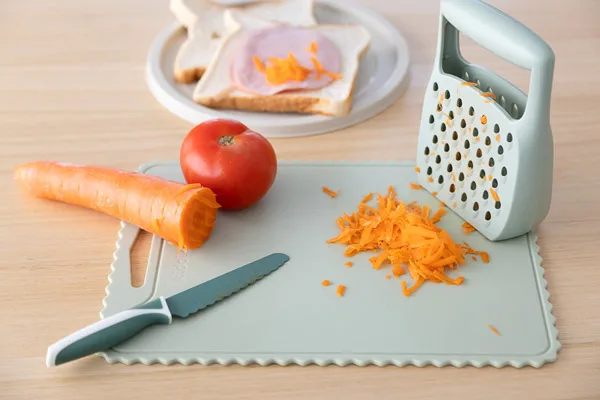
Silicone cutting boards
Practical Applications & Benefits in Real-World Kitchen Settings
Hygienic Food Preparation:
Silicone cutting boards prevent bacterial harboring, are easy to sanitize, and are safe for direct contact with food.
Custom Branding & Design:
Embedded logos or unique textures enhance branding and user experience.
Multi-Functional Use:
Temperature resistance allows for versatile uses, such as serving hot foods or freezing ingredients.
Long-Term Cost Savings:
Durability reduces replacement costs and environmental waste.
Advanced Manufacturing Precision: The LSR Molding Process
Micron-Level Accuracy: The low viscosity of liquid silicone enables it to fill intricate, micron-perfect molds, resulting in products with exceptional dimensional stability and consistent thickness, crucial for a warp-free cutting surface.
Seamless Integration of Components: LSR can be co-molded or overmolded onto other substrates (like tempered glass or reinforced cores) within a single manufacturing cycle, creating hybrid boards that combine a silicone cutting surface with the rigidity of another material.
Reduced Post-Processing: Unlike wood or plastic, LSR parts are often finished as they come out of the mold, requiring no sanding, sealing, or painting, which minimizes human error and potential contamination points.
Enhanced Usability and Maintenance Features
Beyond the core material properties, LSR enables design features that directly affect everyday use:
Juice Grooves and Containment Walls
These can be molded with sharp, clean edges and seamless transitions to the cutting surface, preventing liquid runoff more effectively than machined grooves in wood or plastic.
Dishwasher and Sterilization Safety
While many plastic plates degrade in dishwashers and wooden plates cannot withstand them, the LSR’s stability allows repeated machine washing and even sterilization methods, simplifying cleanup.
Weight and Storage Optimization
With precise engineering, LSR boards can be designed with optimal thickness-to-weight ratios, and flexible variants can be rolled or bent for compact storage, addressing a common kitchen pain point.
The Evolution of Design Language
LSR liberates designers from the constraints of traditional materials, enabling:
Ergonomic Handles and Grips: These can be molded as a continuous, unified part of the board, with soft-grip textures and contours that reduce hand fatigue.
Integrated Kitchen Ecosystem: Designers can create cutting boards that fit perfectly with mixing bowls, fit specific sink dimensions, or include integrated colanders and measuring guides, fostering a cohesive kitchen tool set.
Architectural and Textural Diversity: From sleek, minimalist finishes to pronounced textural patterns that hide knife marks, surface design becomes a key functional and aesthetic choice.
Conclusion
Liquid silicone rubber (LSR) molding represents a breakthrough in producing precision-engineered, safe, and durable cutting boards. Its combination of non-toxic, non-porous surfaces, excellent temperature resistance, and high customization capabilities make it ideal for modern kitchenware. As consumer awareness of food safety and hygiene continues to grow, LSR-based products are poised to become the new standard in kitchen tools, offering both peace of mind and superior performance.
By leveraging the advantages of LSR molding, manufacturers can deliver innovative, high-quality cutting boards that meet the highest standards of safety, functionality and design, taking kitchenware to a new level of excellence.