
Injection Molding vs. 3D Printing: The Complete Comparison
In the rapidly evolving world of manufacturing, two prominent techniques have emerged as game-changers: injection molding and 3D printing. Both methods have their unique advantages, limitations, and ideal applications. Understanding the fundamental principles of each, their pros and cons, and how to choose between them is essential for engineers, entrepreneurs, and manufacturers aiming to optimize production processes. This comprehensive guide delves into the basics of injection molding and 3D printing, compares them in detail, and provides insights into making the right choice for your project.
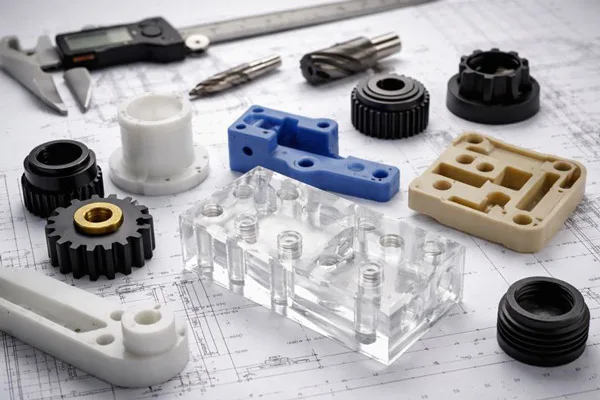
Machined plastic parts
What is Injection Molding?
Injection molding is a high-volume manufacturing process used to produce plastic parts by injecting molten material into a pre-shaped mold cavity. The process involves several steps:
- Designing the Mold: Creating a precise mold that defines the shape of the final product.
- Melting the Material: Heating plastic pellets until they become viscous.
- Injecting the Material: Forcing the molten plastic into the mold cavity under high pressure.
- Cooling and Solidifying: Allowing the material to cool and harden within the mold.
- Ejecting the Part: Removing the finished component from the mold.
This process is highly automated and capable of producing thousands to millions of identical parts rapidly and with high precision.
What is 3D Printing?
3D printing, also known as additive manufacturing, constructs objects layer by layer directly from digital models. The process typically involves:
- Designing a Digital Model: Creating a 3D CAD file.
- Slicing the Model: Dividing the 3D model into thin horizontal layers.
- Layer-by-Layer Construction: The 3D printer deposits material precisely according to the sliced layers.
- Solidification: The material hardens either through cooling or chemical curing, building the part from the ground up.
3D printing is highly versatile, capable of producing complex geometries, prototypes, and small production runs with minimal tooling.
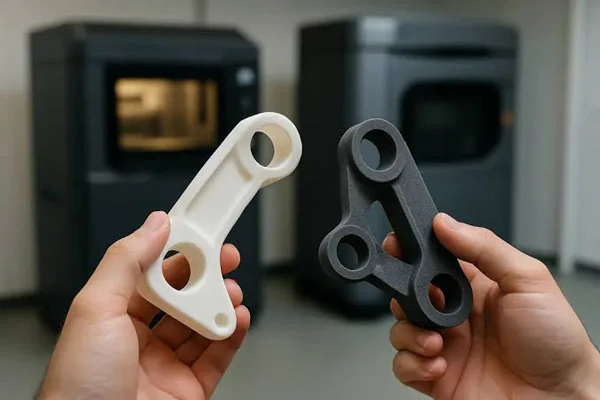
SLS parts
Pros & Cons of Injection Molding When Compared to 3D Printing
Pros:
High Production Volume: Extremely efficient for mass production, with low per-unit cost at scale.
Precision and Consistency: Produces high-quality, uniform parts with tight tolerances.
Material Variety: Supports a wide range of plastics and composites.
Fast Cycle Times: Once the mold is made, parts are produced rapidly.
Cons:
High Initial Cost: Significant investment in mold design and fabrication.
Long Lead Time for Mold Creation: Mold manufacturing can take weeks to months.
Less Flexible for Design Changes: Modifying the mold is costly and time-consuming.
Not Ideal for Low-Volume Runs: Cost-effectiveness diminishes with small production quantities.
Pros & Cons of 3D Printing When Compared to Injection Molding
Pros:
Rapid Prototyping: Fast turnaround from design to physical part.
Low Cost for Small Batches: No need for expensive molds or tooling.
Design Flexibility: Easy to create complex, intricate geometries and design iterations.
Customization: Ideal for one-off parts or personalized products.
Cons:
Slower Production Speed for Large Volumes: Printing takes longer per part compared to injection molding.
Material Limitations: Fewer material options, with some materials not suitable for functional parts.
Surface Finish and Tolerances: Often require post-processing for smooth surfaces and precise dimensions.
Potential for Layer Weakness: Parts may exhibit anisotropic strength due to layered construction.
Material Performance and Mechanical Properties: A Deeper Dive
Injection Molding: The Benchmark for Strength and Durability
Injection molded parts are isotropic, meaning they have uniform mechanical properties in all directions. This is because the material is homogeneously mixed and solidified under high pressure within a heated mold. This results in superior tensile strength, impact resistance, and fatigue performance. Common materials like ABS, polycarbonate, and nylon can be reinforced with glass or carbon fibers to achieve strength comparable to some metals, making them ideal for load-bearing and structural components.
3D Printing: Understanding Anisotropy and Its Limits
Fused Deposition Modeling (FDM), the most common desktop 3D printing method, creates parts that are anisotropic. The bond between layers is typically weaker than the continuous lines within a layer. This can lead to parts that fail along layer lines under stress. In contrast, Stereolithography (SLA) and Selective Laser Sintering (SLS) offer more isotropic properties, though they often lack the impact resistance of their injection-molded counterparts. When selecting 3D printing for functional parts, engineers must carefully evaluate load directions and may need to orient the part or adjust print settings to mitigate potential layer weaknesses.
Environmental Impact and Sustainability Considerations
As sustainability becomes a critical aspect of manufacturing, both injection molding and 3D printing exhibit distinct environmental characteristics.
Injection Molding: Waste Management and Energy Efficiency Injection molding is known for its high efficiency in producing large quantities of parts, thanks to rapid cycle times that lower energy use per unit. However, the process demands considerable energy and raw materials to produce molds, which are typically made from metals with long lifespans. While some waste material can be recycled and reprocessed, the process largely depends on virgin plastics derived from fossil fuels, raising concerns about reliance on non-renewable resources. The durability of metal molds means that the initial environmental impact is amortized over millions of parts, making it a highly sustainable option at high production volumes.
3D Printing: Sustainability Benefits and Energy Drawbacks3D printing provides notable environmental advantages through its ability to produce parts on demand, reducing inventory, overproduction, and the need for extensive transportation. This localized manufacturing approach can significantly lower emissions associated with logistics. For single or small batch productions, 3D printing often results in less material waste compared to traditional subtractive methods. Nevertheless, it tends to consume more energy per part than injection molding. Many 3D printing materials are non-recyclable, although the development of bio-based filaments offers a promising sustainable alternative—though not yet suitable for all applications. The environmental benefit of 3D printing frequently hinges on its capability to create lightweight, topology-optimized components that decrease the overall energy consumption of the final product.
Injection Molding or 3D Printing? Making the Right Call for Your Project
Choosing between these technologies depends on your project requirements:
Volume: Large production runs favor injection molding; small runs or prototypes favor 3D printing.
Time to Market: Need quick prototypes? 3D printing is faster.
Design Complexity: Intricate geometries are easier with 3D printing.
Budget: Low-budget projects benefit from 3D printing; high-volume projects justify mold costs.
Material Needs: Consider available material properties and selection.
Product Lifecycle: For iterative design, 3D printing allows easier modifications.
When Should You Choose Injection Molding Over 3D Printing?
When producing thousands or millions of identical parts.
When high strength, durability, and surface finish are critical.
When long-term cost efficiency is essential.
When the design is finalized and unlikely to change.
When Is 3D Printing Preferred Over Injection Molding?
During the prototyping phase or for testing new designs.
For low-volume, custom, or one-off parts.
When rapid iteration and flexibility are priorities.
For complex geometries that are impossible or costly to mold.
Hybrid Manufacturing: Integrating Injection Molding and 3D Printing
Hybrid manufacturing combines the best of both worlds: 3D printing for rapid prototyping and complex geometries, and injection molding for high-volume production and material diversity. Here’s how three key industries leverage this approach:
Automotive: Engineers 3D print prototype parts for rigorous testing, then seamlessly transition to injection molding for mass production. This accelerates development cycles and slashes time-to-market.
Medical Devices: Custom prosthetics and dental implants are first 3D printed to match patient-specific anatomies. Once validated, injection molding takes over for cost-effective, scalable production—delivering personalization without sacrificing affordability.
Consumer Electronics: Design teams use 3D printing to iterate rapidly on ergonomics and form factors. After finalizing the design, injection molding ensures durable, high-quality finished products at scale, balancing design agility with manufacturing efficiency.
Emerging Technologies and the Future of Manufacturing
The evolution of manufacturing is steering toward a synergy between different methods rather than favoring one over the other. Innovative technologies are increasingly blending the lines between traditional and digital manufacturing processes.
3D-Printed Injection Molds (Rapid Tooling): A notable recent breakthrough is the development of 3D-printed, low-cost temporary molds for injection molding. These molds enable the production of hundreds or even thousands of functional parts in industrial-grade plastics, serving as a practical link between prototyping and large-scale manufacturing. This approach allows companies to validate markets and test products without the high costs associated with conventional steel or aluminum tooling.
Automation and Artificial Intelligence Integration: Both injection molding and 3D printing are benefitting from advances in automation and digital monitoring. Injection molding machines now incorporate sensors and AI-driven systems that track parameters such as pressure, temperature, and viscosity in real-time, ensuring consistent quality. Similarly, 3D printers are utilizing machine learning algorithms to identify and correct errors during the printing process, which reduces failures and improves reliability.
Growth of Metal Manufacturing Technologies: For metal components, methods like Metal Injection Molding (MIM) are paving the way for producing complex, high-volume metal parts efficiently. Concurrently, techniques like Binder Jetting are advancing rapidly, allowing for the on-demand production of metal components at speeds that are beginning to rival traditional manufacturing, all without the need for costly tooling.
Conclusion
Injection molding and 3D printing are powerful manufacturing techniques, each suited to specific stages of product development and production needs. Injection molding excels in high-volume, cost-effective production with excellent part quality, while 3D printing offers unmatched flexibility, rapid prototyping, and low-volume manufacturing. Understanding their principles, advantages, and limitations enables informed decision-making tailored to your project’s goals, budget, and timeline.
Whether you’re designing a prototype, creating small batches, or mass-producing products, selecting the right method can dramatically impact your success. In many cases, integrating both technologies into a hybrid manufacturing strategy can provide the best of both worlds, ensuring efficiency, quality, and innovation.