
Metal Punching vs. Stamping: What’s the Difference?
In the world of metal fabrication, two processes often come up in conversation: punching and stamping. At first glance, they may seem similar—both use presses and tooling to shape or cut sheet metal. However, they serve fundamentally different purposes, employ distinct mechanisms, and are suited to different production scales and part geometries. Understanding the differences between metal punching and stamping is essential for engineers, designers, and procurement professionals who need to choose the most cost-effective and efficient manufacturing method for their projects.
This article explores both processes in depth, covering what stamping and punching are, their respective advantages and limitations, and nine key differences that set them apart.
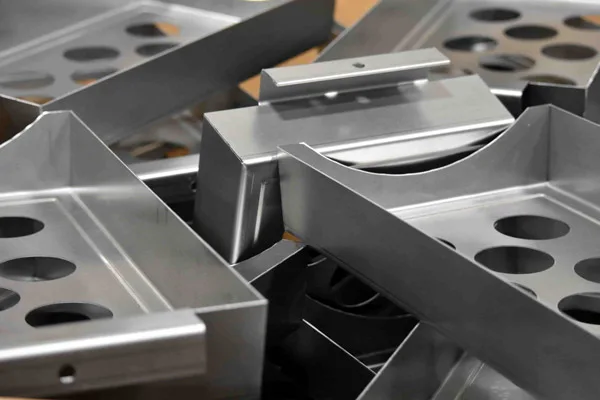
Metal stamping
What’s Stamping?
Stamping is a broad metal forming process that uses a press and tooling to transform flat sheet metal into a desired shape. Unlike cutting-only operations, stamping encompasses a variety of techniques, including blanking, bending, embossing, coining, drawing, and piercing. The process is typically performed in a single press stroke or a series of strokes, often with progressive dies that perform multiple operations as the metal strip moves through the press.
Stamping is a high-volume manufacturing method. Once the dies are designed and manufactured, the process can produce thousands or even millions of identical parts with exceptional repeatability. Stamping presses range from small mechanical presses of 20 tons to massive hydraulic presses exceeding 10,000 tons, capable of forming large automotive body panels.
Key Characteristics of Stamping:
- Material deformation: The metal is plastically deformed, often changing its shape significantly.
- Tooling complexity: Dies are complex, often with multiple stations that perform cutting, bending, and forming in sequence.
- Production volume: Best suited for medium to high volume runs due to high die costs.
- Part complexity: Can produce intricate geometries, including three-dimensional shapes with curves, ribs, and flanges.
Common applications of stamping include automotive body panels, appliance housings, electronic enclosures, and aerospace components.
Advantages of Metal Stamping
High Production Speed
Stamping presses can operate at high speeds—mechanical presses can deliver hundreds of strokes per minute. With progressive dies, a single press cycle can complete multiple operations, resulting in finished parts at rates that other processes cannot match.
Exceptional Consistency and Repeatability
Once the dies are dialed in, stamping produces parts with tight tolerances and minimal variation. This repeatability is critical for industries like automotive and aerospace, where parts must be interchangeable without modification.
Complex Geometries in One Operation
Progressive and transfer dies allow complex parts to be formed, pierced, and cut in a single press run. This reduces handling, labor, and the need for secondary operations.
Material Efficiency
Stamping can be arranged with nested layouts to minimize scrap between parts. Coil-fed stamping lines further reduce material waste by feeding the exact width needed.
Wide Range of Materials and Thicknesses
Stamping works with most metals, including steel, stainless steel, aluminum, copper, brass, and exotic alloys. Thicknesses can range from thin foils to heavy-gauge plates, depending on press capacity.
Scalability
From small precision parts to large structural components, stamping can be scaled to suit the part size and production volume. Hydraulic presses excel at deep draws and large panels.
Limitations of Metal Stamping
High Initial Tooling Cost
Stamping dies are expensive to design, build, and test. A single progressive die can cost tens of thousands to hundreds of thousands of dollars. This makes stamping economically prohibitive for low-volume production or prototyping.
Long Lead Times for Tooling
Die fabrication is a specialized, time-consuming process. Lead times of 8 to 20 weeks are common, which can delay product launch schedules.
Design Changes Are Costly
Once a die is hardened and tested, modifying it to accommodate design changes is difficult and expensive. Stamping is best suited for mature designs that are unlikely to change.
Not Ideal for Low Volumes
Due to high tooling costs and setup time, stamping is not cost-effective for quantities under a few thousand parts unless the parts are very simple.
Physical Limitations on Forming
Some shapes—such as parts with undercuts, very sharp internal corners, or extreme depth-to-diameter ratios—may be impossible or impractical to stamp without multiple operations and specialized tooling.
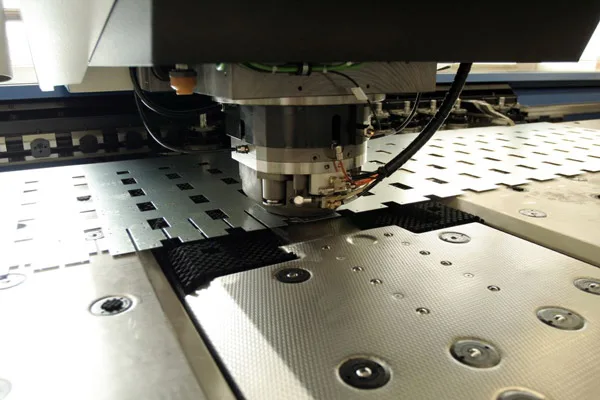
Metal punching
What Is Metal Punching?
Metal punching, often referred to as punching or turret punching, is a metal fabrication process specifically designed to create holes, cutouts, and contours in sheet metal. It uses a punch and a matching die. The punch is driven through the workpiece, shearing the metal and ejecting a slug through the die.
In its simplest form, punching is a hole-making operation. However, modern CNC punch presses can perform a wide range of operations, including:
- Hole punching: Round, square, oblong, or custom-shaped holes.
- Nibbling: Making cutouts larger than the available tool by overlapping punches.
- Forming: Louvers, countersinks, embossing, and even simple bending using special tooling.
- Marking: Indenting part numbers or alignment marks.
Unlike stamping, which typically uses dedicated dies for each part, punching is often performed on a single machine with a turret containing dozens of tools. The machine selects tools and moves the sheet under program control, making it highly flexible for low-to-medium volume production.
Key Characteristics of Punching:
- Material removal: The primary action is shearing rather than bulk deformation.
- Tooling modularity: A single machine can run many different parts without changing tooling setups.
- Production volume: Ideal for prototypes, low-volume runs, and custom parts.
- Part complexity: Best for 2D shapes and parts with cutouts; limited in three-dimensional forming capability.
Advantages of Punching
Low Setup Costs and Short Lead Times
Because CNC punch presses use standard tooling libraries, there is no need to build expensive custom dies for many applications. Programming can be done in hours or days, allowing rapid turnaround for prototypes and short-run production.
Design Flexibility
Design changes can be accommodated by simply updating the CNC program. This makes punching ideal for iterative product development and custom fabrication jobs.
Cost-Effective for Low to Medium Volumes
Without the burden of die amortization, punching is economical for quantities ranging from one to several thousand parts. It bridges the gap between manual fabrication and high-volume stamping.
Versatility in One Machine
A modern CNC turret punch can perform punching, forming, marking, and even limited forming operations in a single setup. This reduces the need for multiple machines or secondary operations.
Quick Turnaround for Prototypes
Punching is often used for functional prototypes because it produces parts from actual production-grade materials with realistic mechanical properties—unlike 3D-printed or laser-cut prototypes that may not replicate formed features.
Integration with Other Processes
Punching can be combined with laser cutting on hybrid machines, offering the flexibility of laser for complex contours and the speed of punching for repetitive holes.
Metal Punching vs. Stamping: 9 Differences
While both processes are essential in metal fabrication, they differ in fundamental ways. Understanding these nine differences will help you choose the right method for your application.
1. Primary Mechanism: Cutting vs. Forming
Punching is primarily a shearing process. It removes material by forcing a punch through the sheet, creating holes or cutouts. While punching can perform some forming, its core function is material removal.
Stamping is primarily a forming process. It reshapes the metal through plastic deformation. Even when stamping includes cutting operations, the overall process is oriented toward creating three-dimensional shapes.
2. Tooling Philosophy
Punching uses modular, standard tooling. A CNC turret punch holds dozens of punch-and-die sets that can be combined in different sequences to produce varied parts. Custom tooling is available but often not required for common features.
Stamping relies on dedicated, custom dies. Each part or family of parts requires its own die set, which is designed specifically for that geometry. Dies are expensive and have long lead times but offer high efficiency for mass production.
3. Production Volume Suitability
Punching excels at low to medium volumes. It is ideal for prototypes, custom work, and just-in-time manufacturing.
Stamping is designed for medium to high volumes. The high tooling cost is amortized over large quantities, making per-part cost very low at scale.
4. Part Complexity
Punching produces primarily 2D or 2.5D parts. It can create cutouts, holes, and simple formed features but cannot create deep draws, complex curves, or intricate three-dimensional shapes.
Stamping can produce complex 3D parts including deep-drawn cups, automotive body panels, and components with multiple bends and contours in a single die progression.
5. Material Utilization and Scrap
Punching creates scrap slugs for every hole or cutout. For parts with many holes, scrap can be significant. However, modern nesting software minimizes waste.
Stamping can achieve higher material utilization, especially with progressive dies and coil feed. Blanking and forming can be arranged to nest parts efficiently, and there are no slug remnants from individual holes.
6. Speed and Cycle Time
Punching involves tool changes and sheet movement. Cycle time per part is longer, especially for parts with many features, as the machine indexes the sheet between hits. Typical hit rates range from 100 to 600 hits per minute, but sheet positioning adds time.
Stamping can be extremely fast. A mechanical press running a progressive die can produce finished parts at rates of 60 to over 1,000 strokes per minute, with each stroke yielding one or more parts.
7. Setup and Changeover
Punching offers quick changeover. Changing from one part to another often just requires loading a new CNC program; tool selection is automatic from the turret. Changeover times are typically minutes.
Stamping involves lengthy changeovers. Changing dies in a press requires crane handling, bolting, die setting, and initial test runs. Changeover can take hours, which is why stamping is typically run in long production batches.
8. Thickness Range
Punching is generally limited to thinner sheet metals, typically up to about 0.25 inch in mild steel, and less for harder materials. Beyond this, the required tonnage and tool wear become prohibitive.
Stamping can handle a wider thickness range, from very thin foils to heavy plates over 1 inch, depending on press size and die design. Hot stamping can even work with thicker materials.
9. Typical Industries and Applications
Punching is common in industries that require custom enclosures, brackets, chassis, and panels with cutouts—such as electronics, telecommunications, medical devices, and architectural metalwork. It is also widely used in job shops and fabrication facilities that handle low-volume custom work.
Stamping dominates high-volume industries like automotive, appliances, aerospace, and consumer goods.
Comparative Summary Table
|
Aspect |
Metal Punching |
Metal Stamping |
| Primary Process | Shearing / cutting | Forming / deformation |
| Tooling | Modular, standard tools | Custom, dedicated dies |
| Volume Suitability | Low to medium (1 – 10,000+ parts) | Medium to high (thousands – millions) |
| Part Complexity | 2D / 2.5D; cutouts, holes, simple forms | Complex 3D; deep draws, curves, flanges |
| Material Utilization | Moderate; slug scrap | High; nested blanking, coil feed |
| Speed | Moderate; tool changes and sheet movement | Very fast; progressive dies |
| Changeover | Quick (minutes) | Slow (hours) |
| Thickness | Typically up to 1/4″ (mild steel) | Foil to heavy plate, depending on press |
| Cost Structure | Low tooling cost; higher per-part cost | High tooling cost; low per-part cost at volume |
| Typical Industries | Electronics, telecom, job shops, prototypes | Automotive, appliances, aerospace, mass production |
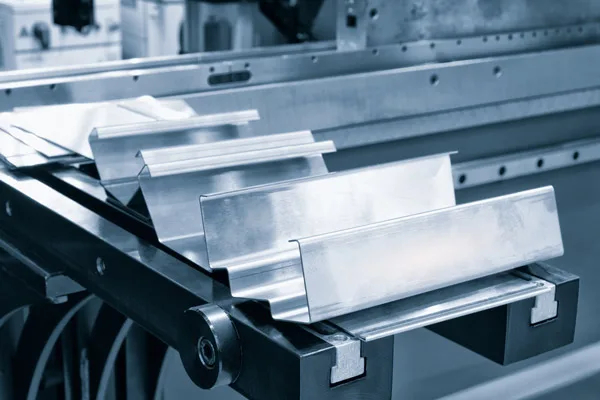
Metal bending
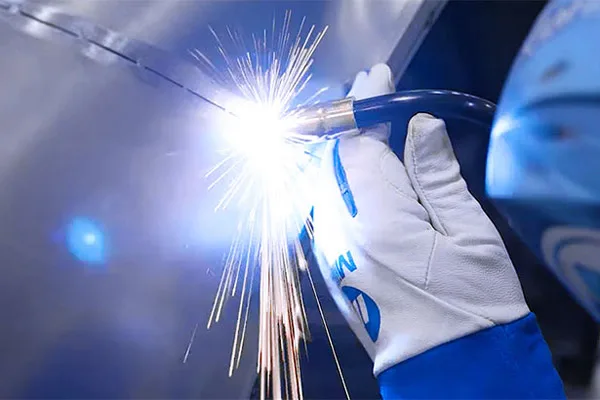
Metal welding
Choosing Between Punching and Stamping
Selecting the right process depends on your project requirements. Here are some guiding questions to ask:
What is your production volume?
For prototypes or batches under a few thousand pieces, punching is usually more economical and faster to market. For production runs exceeding 10,000 pieces, stamping’s lower per-part cost often justifies the tooling investment.
What is the part geometry?
If your part is mostly flat with cutouts, holes, and simple bends, punching is a natural fit. If it requires deep draws, complex curves, or multiple forming operations in a single die, stamping is necessary.
How quickly do you need parts?
Punching offers rapid turnaround because there is no die fabrication wait. Stamping requires die development, which can take weeks or months.
Is design flexibility important?
If your design is still evolving or you anticipate future modifications, punching allows easy changes via software updates. Stamping locks in the design once the die is built.
What is your budget for tooling?
Punching has minimal tooling costs if standard tools can be used. Stamping requires significant upfront investment, which must be amortized over the production run.
Conclusion
Metal punching and stamping are both essential processes in modern manufacturing, but they serve distinct roles. Punching offers flexibility, quick turnaround, and low tooling costs, making it ideal for low-to-medium volume production of parts with cutouts and simple forms. Stamping, with its high-speed capabilities, ability to create complex three-dimensional shapes, and exceptional consistency, is the backbone of high-volume industries such as automotive and appliance manufacturing.
By understanding the nine key differences – from tooling philosophy and volume to component complexity and speed – you can make informed decisions that balance cost, lead time and technical requirements. In many cases, the two processes are complementary: prototyping and low-volume production may use stamping, while successful products transition to stamping for mass production. Either way, knowing when to punch and when to stamp is a hallmark of a smart metal fabrication strategy.