
In the vast landscape of manufacturing, few processes have achieved the ubiquity and enduring relevance of plastic injection molding. From tiny gears in wristwatches and the intricate housing of smartphones to robust components under car hoods and one-off items in hospitals, injection-molded parts are ubiquitous. This dominance is no accident. It is the result of a powerful combination of economic, technical and practical advantages that make it uniquely suited for mass production. Here are the top reasons why injection molding remains the go-to manufacturing method for creating high volume plastic and increasingly metal parts.
1. Unbeatable Economics of Scale: The Low Cost Per Part
This is the single most compelling reason for its popularity. While the initial investment is high, it covers the cost of precision-engineered steel molding – a cost that amortizes over hundreds of thousands, if not millions, of parts.
High Upfront, Low Marginal Cost: Once the mold is built and installed in the injection molding machine, the cost to produce each subsequent unit plummets. The process is highly automated and cycle times are often measured in seconds. This results in an exceptionally low cost per parton at high volumes, a metric against which few other processes can compete.
Efficiency and Automation: Modern injection molding presses run with minimal human intervention. Robots handle part removal, and integrated systems manage material drying, conveying, and mixing, keeping labor costs a very small fraction of the total production cost.
2. Exceptional Production Speed and High Output
Injection molding is built for speed. Once a mold is running optimally, it can produce parts in rapid, continuous cycles.
- Fast Cycle Times: Complex parts can be formed, cooled, and ejected in as little as 10-30 seconds. Simpler, smaller parts can have cycle times of just a few seconds. This relentless pace allows a single machine to produce a staggering number of parts per day, making it ideal for meeting large-scale demand.
- High-Volume Capacity: The combination of fast cycling and the ability to use multi-cavity molds or family molds multiplies output exponentially.
3. Unmatched Material Versatility and Performance
Engineers are not limited to a single type of plastic. This process is compatible with a wide array of polymers, each offering different properties to meet specific application needs.
Wide Polymer Selection: From common thermoplastics like ABS, polypropylene, and polycarbonate to advanced engineering resins like PEEK, PPS, and liquid crystal polymers, the choice is extensive. Materials can be chosen for strength, flexibility, heat resistance, chemical resistance, biocompatibility, or transparency.
Advanced Material Formulations: Reinforcements like glass or carbon fiber can be added to resins to dramatically enhance strength and stiffness. Additives can provide UV resistance, flame retardancy, anti-static properties, or specific colors.
4. Superior Repeatability and Part Consistency
For a mass-produced item, every component must be virtually identical to ensure proper assembly, functionality and safety. Injection molding excels at this.
- Precision Tooling: The mold, machined from hardened steel with extreme precision, defines the part’s geometry. Each cycle, the molten material is forced into this identical cavity, producing a section with remarkable dimensional consistency and tight tolerances.
- Process Control: Modern machines are computer-controlled and meticulously manage variables such as temperature, pressure, injection speed and cooling time.
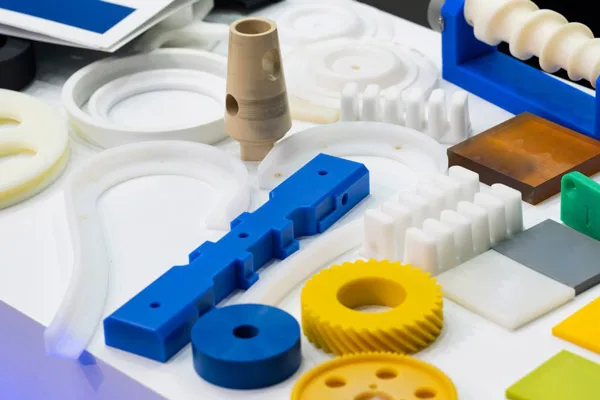
Plastics products
5. Design Flexibility and Complexity in a Single Part
Injection molding allows the creation of highly complex, intricate geometries that would be impossible or prohibitively expensive to achieve with other methods such as machining or fabrication.
All-in-One Manufacturing: A single injection-molded part can incorporate multiple features: ribs for strength, bosses for screwing, live hinges, snap-fits, and complex internal channels. This component consolidation reduces assembly time, reduces the number of components, reduces inventory costs, and can improve overall product reliability.
Fine Details and Textures: The surface of the mold can be etched or machined to impart detailed textures, logos or part numbers directly onto the part during the molding process, eliminating secondary printing or engraving steps.
6. Excellent Surface Finish and Strength
The parts emerge from the mold with a high-quality, finished appearance right off the machine.
- Mold-Finish Dependent: A highly polished mold cavity will produce a glossy, ready-to-use part. Textured or matte finishes are also directly achievable. This often reduces or eliminates the need for post-processing.
- Inherent Material Strength: Unlike subtractive processes that cut away material and can create weak points, injection molding produces parts with consistent strength. The plastic flows and solidifies under pressure, filling the mold completely to create a homogeneous structure.
Considerations and the Path Forward
While its advantages are profound, injection molding does have prerequisites. The high cost and lead time of tooling makes it less suitable for very low volume production or for products still in the early stages of iterative prototyping. Additionally, designing for manufacturability (DFM) is critical to avoid costly mold rework.
Conclusion
Injection molding’s popularity is firmly rooted in its ability to address the central challenge of modern manufacturing: how to produce large quantities of high-quality, complex, affordable parts with relentless efficiency. Its triumvirate of low per-part cost, high output speed and exceptional repeatability make it an indispensable pillar in industries ranging from consumer electronics and automotive to medical devices and packaging. As materials science advances – with more sustainable biopolymers and recycled resins – and process controls become smarter, injection molding is poised to maintain its dominant role in shaping the physical world around us for decades to come.